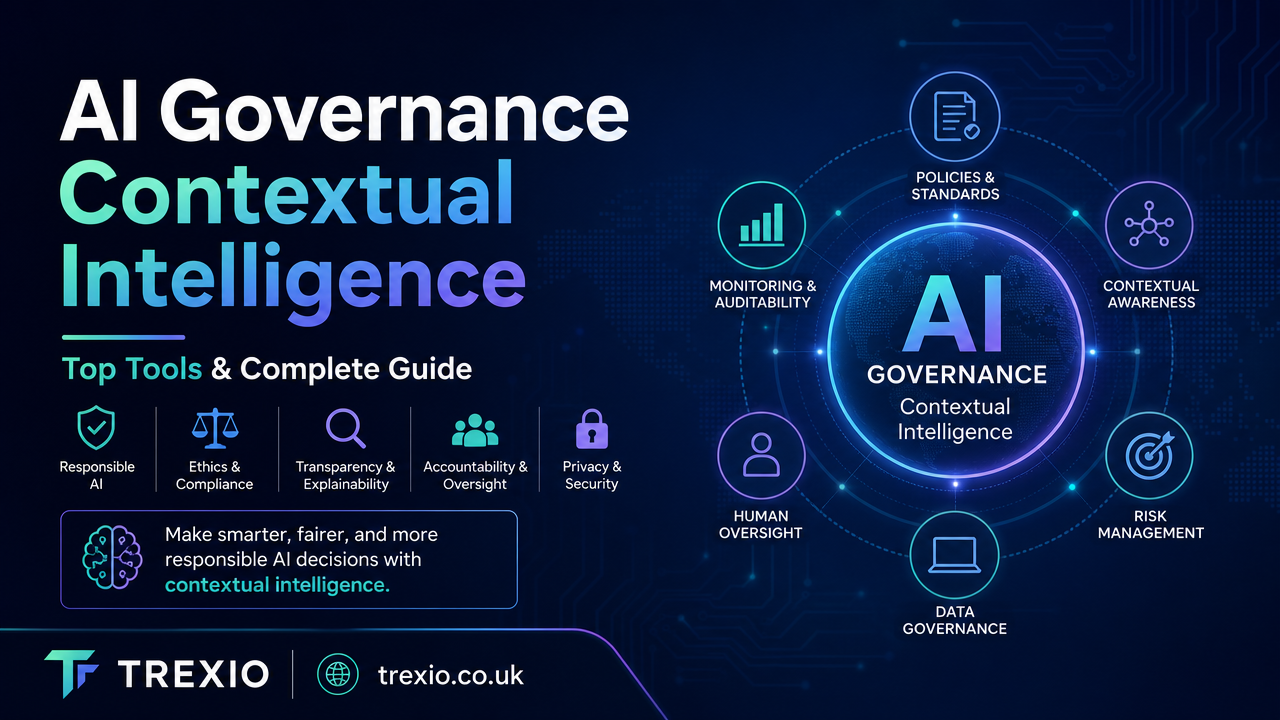
AI Governance Contextual Intelligence Top Tools & Complete Guide
As organizations rapidly adopt artificial intelligence, maintaining transparency, accountability, and regulatory compliance has become more challenging than ever. This is where ai governance contextual intelligence plays a critical role. Instead of simply monitoring AI systems, ai governance contextual intelligence provides the context behind every AI decision, helping organizations understand why models behave in certain ways and whether they align with business goals and regulations.
Modern enterprises increasingly rely on ai governance contextual intelligence to reduce bias, improve explainability, strengthen security, and ensure responsible AI deployment. Whether you manage machine learning models, generative AI applications, or enterprise automation, implementing ai governance contextual intelligence helps build trust while minimizing operational risks.
As AI regulations continue evolving worldwide, businesses investing in ai governance contextual intelligence gain a competitive advantage by improving compliance, operational efficiency, and decision transparency. This guide explores the best software solutions, their capabilities, and how organizations can benefit from ai governance contextual intelligence.
Quick Summary
- ai governance contextual intelligence helps organizations govern AI responsibly.
- Improves transparency and explainability across AI models.
- Supports regulatory compliance and audit readiness.
- Detects risks, bias, and model drift.
- Strengthens enterprise AI security.
- Enables better human oversight.
- Reduces compliance costs.
- Builds stakeholder trust.
- Works with machine learning and generative AI.
- Choosing the right platform depends on business size, compliance requirements, integrations, and automation features.
What Is AI Governance Contextual Intelligence?
Understanding the Concept
AI governance contextual intelligence combines AI governance practices with contextual understanding of data, business objectives, compliance policies, and operational environments. Unlike traditional governance, ai governance contextual intelligence evaluates not only what an AI model predicts but also why those predictions occur within specific business contexts.
Organizations using ai governance contextual intelligence gain greater visibility into model performance, decision history, data lineage, policy enforcement, and regulatory compliance.
Why It Matters
Businesses adopting ai governance contextual intelligence experience several important benefits:
- Better AI transparency
- Improved compliance reporting
- Faster audits
- Reduced algorithmic bias
- Stronger data governance
- More reliable AI decisions
- Increased customer trust
- Better risk management
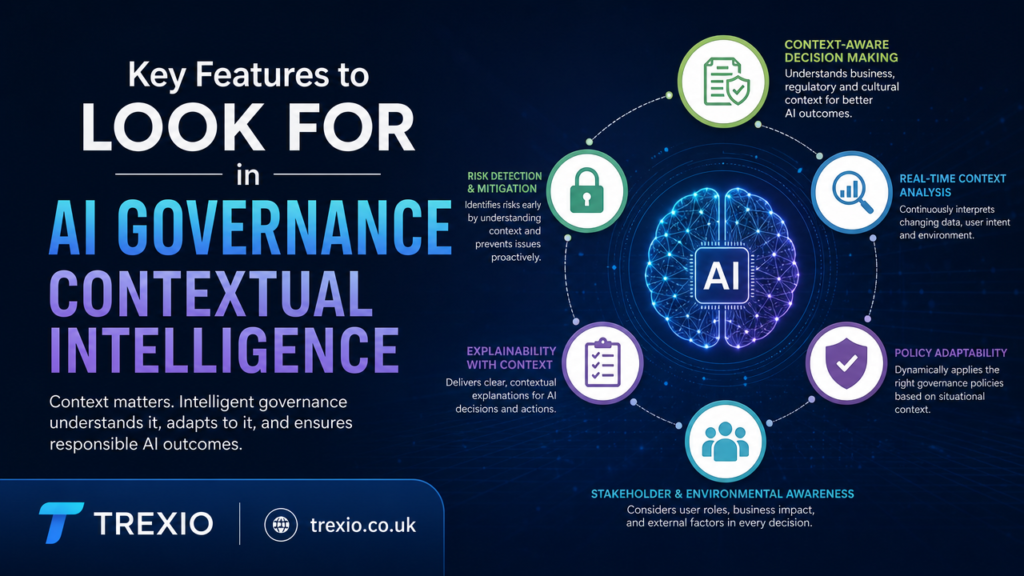
Key Features to Look For
Explainability
A quality ai governance contextual intelligence platform should clearly explain model outputs and decision paths.
Risk Monitoring
Continuous monitoring identifies unexpected behavior before it affects business operations.
Compliance Automation
Automated reporting saves valuable time during internal and external audits.
Bias Detection
Bias monitoring helps organizations deploy fair and ethical AI systems.
Data Lineage
Tracking datasets from source to prediction ensures accountability throughout the AI lifecycle.
Top AI Governance Contextual Intelligence Software Comparison
| # | Software | Best For | Key Features | Free Plan | Starting Price |
|---|---|---|---|---|---|
| 1 | IBM watsonx.governance | Large Enterprises | AI governance, explainability, compliance automation, risk monitoring | No | Custom |
| 2 | Microsoft Purview | Microsoft Ecosystem | Data governance, AI compliance, policy management | Limited | Custom |
| 3 | DataRobot AI Governance | ML Operations | Model monitoring, bias detection, lifecycle governance | No | Custom |
| 4 | Fiddler AI | Explainable AI | Model explainability, fairness monitoring, drift detection | Limited | Custom |
| 5 | Arthur AI | AI Monitoring | Performance monitoring, contextual insights, governance dashboards | No | Custom |
Benefits of AI Governance Contextual Intelligence
Improved Decision Transparency
Organizations implementing ai governance contextual intelligence gain deeper visibility into model decisions, helping employees, executives, customers, and regulators understand AI-generated outcomes with confidence.
Stronger Regulatory Compliance
As governments introduce stricter AI regulations, ai governance contextual intelligence simplifies documentation, policy enforcement, and audit preparation while reducing legal risks.
Better Risk Management
Continuous monitoring enables businesses to identify anomalies, policy violations, and performance degradation before they become significant operational problems.
Increased Trust
Trust remains essential for AI adoption. ai governance contextual intelligence promotes responsible AI practices that improve confidence among customers, employees, investors, and regulators.
Who Should Use AI Governance Contextual Intelligence?
Organizations that benefit the most include:
- Financial institutions
- Healthcare providers
- Government agencies
- Insurance companies
- Retail enterprises
- Manufacturing organizations
- AI startups
- Technology companies
- Research institutions
- Enterprise AI teams
The growing adoption of ai governance contextual intelligence across these industries reflects its importance in building secure, transparent, and compliant AI systems.
Google Cloud Vertex AI
Google Cloud Vertex AI provides governance capabilities alongside machine learning development. It includes model monitoring, metadata tracking, security controls, and responsible AI features. Organizations using ai governance contextual intelligence can leverage Vertex AI to improve transparency and automate governance across the AI lifecycle.
Amazon SageMaker
Amazon SageMaker includes governance tools such as model cards, lineage tracking, monitoring, and compliance reporting. It helps organizations implement ai governance contextual intelligence while maintaining secure and scalable AI deployments in cloud environments.
Credo AI
Credo AI focuses specifically on responsible AI governance. It offers policy management, compliance frameworks, risk assessments, and automated documentation. Businesses seeking comprehensive ai governance contextual intelligence often choose Credo AI for its governance-first approach.
Holistic AI
Holistic AI enables organizations to assess fairness, bias, explainability, and regulatory compliance across multiple AI systems. Its dashboards simplify ai governance contextual intelligence by providing centralized oversight and continuous monitoring.
Monitaur
Monitaur specializes in AI governance, model documentation, audit readiness, explainability, and regulatory reporting. It helps enterprises establish effective ai governance contextual intelligence programs while improving accountability and transparency.
Feature Comparison Table
| Software | Explainability | Bias Detection | Compliance | Risk Monitoring | Model Monitoring | Data Lineage | Enterprise Ready |
|---|---|---|---|---|---|---|---|
| IBM watsonx.governance | ✓ | ✓ | ✓ | ✓ | ✓ | ✓ | ✓ |
| Microsoft Purview | Limited | Limited | ✓ | ✓ | Limited | ✓ | ✓ |
| DataRobot AI Governance | ✓ | ✓ | ✓ | ✓ | ✓ | ✓ | ✓ |
| Fiddler AI | ✓ | ✓ | Limited | ✓ | ✓ | Limited | ✓ |
| Arthur AI | ✓ | ✓ | Limited | ✓ | ✓ | Limited | ✓ |
| Google Cloud Vertex AI | ✓ | Limited | ✓ | ✓ | ✓ | ✓ | ✓ |
| Amazon SageMaker | ✓ | Limited | ✓ | ✓ | ✓ | ✓ | ✓ |
| Credo AI | ✓ | ✓ | ✓ | ✓ | Limited | ✓ | ✓ |
| Holistic AI | ✓ | ✓ | ✓ | ✓ | ✓ | Limited | ✓ |
| Monitaur | ✓ | ✓ | ✓ | ✓ | ✓ | ✓ | ✓ |
Pricing Comparison Table
| Software | Free Version | Trial | Pricing Model |
| IBM watsonx.governance | No | Demo | Custom Quote |
| Microsoft Purview | Limited | Yes | Pay-as-you-go |
| DataRobot AI Governance | No | Demo | Custom Quote |
| Fiddler AI | Limited | Yes | Custom Quote |
| Arthur AI | No | Demo | Custom Quote |
| Google Cloud Vertex AI | Limited | Yes | Usage-based |
| Amazon SageMaker | Limited | Yes | Pay-as-you-go |
| Credo AI | No | Demo | Custom Quote |
| Holistic AI | No | Demo | Custom Quote |
| Monitaur | No | Demo | Custom Quote |
How to Choose AI Governance Contextual Intelligence Software
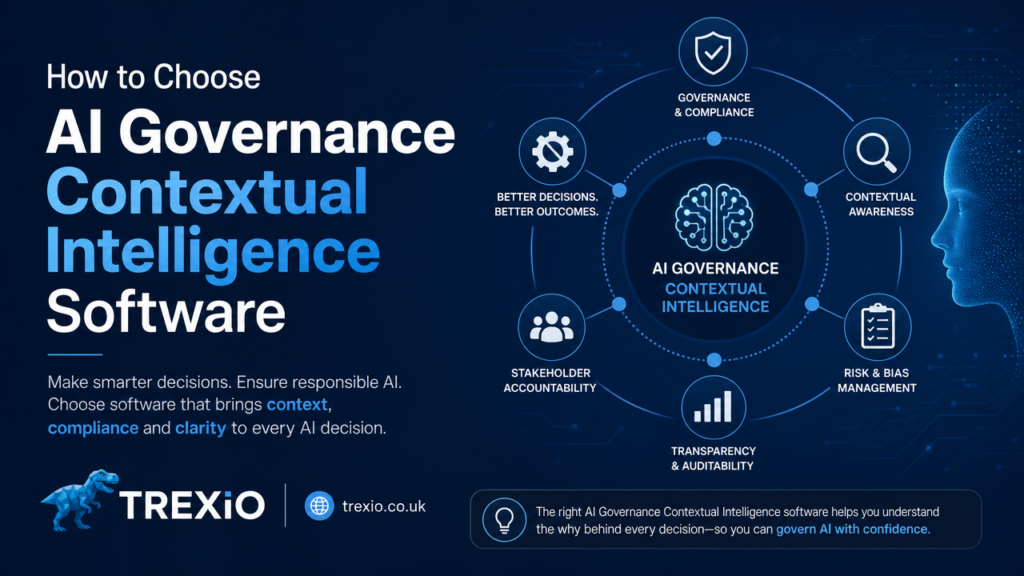
Selecting the right ai governance contextual intelligence platform depends on your organization’s AI maturity, compliance obligations, and deployment environment. Consider these factors before making a decision:
- Support for relevant AI regulations and industry standards.
- Strong explainability and transparency features.
- Continuous model monitoring and drift detection.
- Bias detection and fairness assessment.
- Data lineage and audit trail capabilities.
- Integration with your existing cloud and AI infrastructure.
- Scalability for enterprise workloads.
- Ease of implementation and user-friendly dashboards.
- Vendor support and product roadmap.
- Total cost of ownership.
Our Recommendation
For large enterprises with complex governance requirements, IBM watsonx.governance stands out due to its comprehensive governance capabilities, explainability features, and compliance support.
Organizations heavily invested in Microsoft technologies may benefit most from Microsoft Purview because of its seamless integration across the Microsoft ecosystem.
Companies building machine learning models at scale should consider DataRobot AI Governance for its strong monitoring and lifecycle management features.
Businesses seeking dedicated responsible AI governance may find Credo AI or Monitaur to be excellent choices due to their focus on policy management, audits, and regulatory compliance.
Ultimately, the best ai governance contextual intelligence solution is the one that aligns with your compliance requirements, AI maturity, budget, and long-term governance strategy.
Conclusion
As artificial intelligence becomes central to business operations, implementing ai governance contextual intelligence is no longer optional. Organizations must ensure that AI systems remain transparent, fair, secure, and compliant throughout their lifecycle.
The software solutions covered in this guide provide a range of governance capabilities—from explainability and bias detection to audit readiness and automated compliance reporting. Evaluating your organization’s goals, regulatory requirements, and technical ecosystem will help you select the most appropriate platform.
Investing in ai governance contextual intelligence today enables organizations to reduce risks, strengthen stakeholder trust, and confidently scale AI initiatives for the future.
Frequently Asked Questions
1. What is AI governance contextual intelligence?
It is the practice of combining AI governance with contextual understanding to improve transparency, compliance, explainability, and responsible AI decision-making.
2. Why is AI governance important?
It helps organizations reduce risks, comply with regulations, detect bias, and build trust in AI systems.
3. Which industries need AI governance the most?
Healthcare, finance, government, insurance, retail, manufacturing, and technology companies benefit significantly from AI governance.
4. Can small businesses use AI governance platforms?
Yes. Many cloud-based platforms provide scalable solutions suitable for organizations of all sizes.
5. What features should I prioritize?
Look for explainability, compliance automation, bias detection, model monitoring, risk management, and data lineage.
6. Is AI governance required by law?
Requirements vary by jurisdiction, but many regions are introducing regulations that make AI governance increasingly important.
7. How does contextual intelligence improve governance?
It adds business, operational, and regulatory context to AI decisions, making governance more accurate and actionable.
8. Which software is best overall?
The ideal choice depends on your environment and requirements, but IBM watsonx.governance, DataRobot AI Governance, and Credo AI are among the strongest enterprise options.
Quick Bio
Author: SEO Editorial Team
The SEO Editorial Team specializes in researching emerging technologies, enterprise software, artificial intelligence, cloud computing, cybersecurity, and digital transformation. Our goal is to create accurate, practical, and easy-to-understand content that helps businesses and professionals make informed technology decisions while staying current with industry trends.