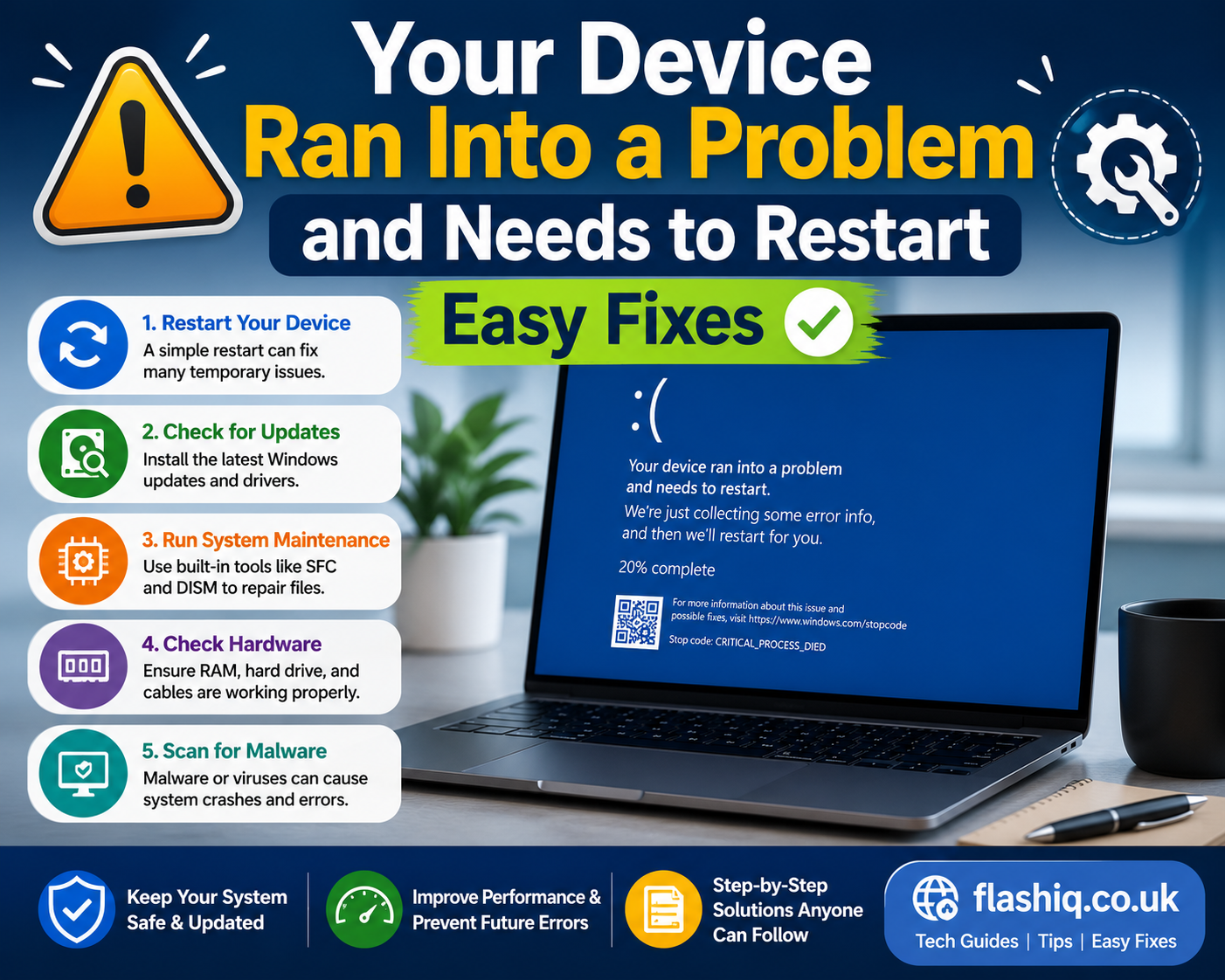
Your Device Ran Into a Problem and Needs to Restart Easy Fixes
Seeing the message your device ran into a problem and needs to restart can be frustrating, especially when you’re working on something important. This Windows Blue Screen of Death (BSOD) error appears when the operating system encounters a critical issue that prevents it from running safely. Although the message may look alarming, it doesn’t always mean your computer has serious hardware damage.
In many cases, your device ran into a problem and needs to restart is caused by outdated drivers, corrupted system files, faulty RAM, incompatible software, Windows updates, or hardware conflicts. The good news is that most users can solve your device ran into a problem and needs to restart without replacing their computer or reinstalling Windows.
This guide explains why your device ran into a problem and needs to restart appears, the most common causes, proven troubleshooting methods, and useful software that can help diagnose and repair Windows issues. Whether the error occurs once or repeatedly, the solutions below will help you get your PC working normally again.
Quick Summary
If you’re seeing your device ran into a problem and needs to restart, here’s what you should know:
- The error is a Windows Blue Screen of Death (BSOD).
- It usually happens because of driver, hardware, or system file problems.
- Restarting alone may not permanently fix the issue.
- Windows diagnostic tools can identify many causes.
- Updating drivers often resolves your device ran into a problem and needs to restart.
- Corrupted Windows files frequently trigger the error.
- Faulty RAM or SSDs can also cause repeated crashes.
- Malware and incompatible software may contribute to system instability.
- Several repair utilities can simplify troubleshooting.
- Most users can fix your device ran into a problem and needs to restart without reinstalling Windows.
Why Does “Your Device Ran Into a Problem and Needs to Restart” Appear?
The message your device ran into a problem and needs to restart appears when Windows detects a fatal system error that could damage files or cause instability if the operating system continued running.
Instead of allowing Windows to keep operating incorrectly, Microsoft designed the system to stop immediately and display the blue error screen. This safety feature protects your data while creating diagnostic information that can help identify what caused your device ran into a problem and needs to restart.
The error may happen during startup, gaming, software installation, Windows updates, or even while your computer is idle.
Common Causes of the Error
Driver Problems
Old, damaged, or incompatible drivers are among the leading reasons your device ran into a problem and needs to restart appears. Graphics drivers, chipset drivers, storage drivers, and network drivers commonly trigger BSOD errors.
Corrupted Windows System Files
If essential Windows files become corrupted because of improper shutdowns, failed updates, or malware infections, Windows may display your device ran into a problem and needs to restart repeatedly.
Faulty RAM
Memory problems can interrupt Windows operations unexpectedly. A failing RAM module often causes random crashes accompanied by your device ran into a problem and needs to restart.
Hardware Failures
Failing SSDs, hard drives, motherboards, graphics cards, and power supplies may all generate the your device ran into a problem and needs to restart message.
Windows Update Issues
Some Windows updates may conflict with existing drivers or software, leading to your device ran into a problem and needs to restart shortly after installation.
Malware
Although less common, malware infections can corrupt Windows components and trigger your device ran into a problem and needs to restart unexpectedly.
Signs That the Problem Is Serious
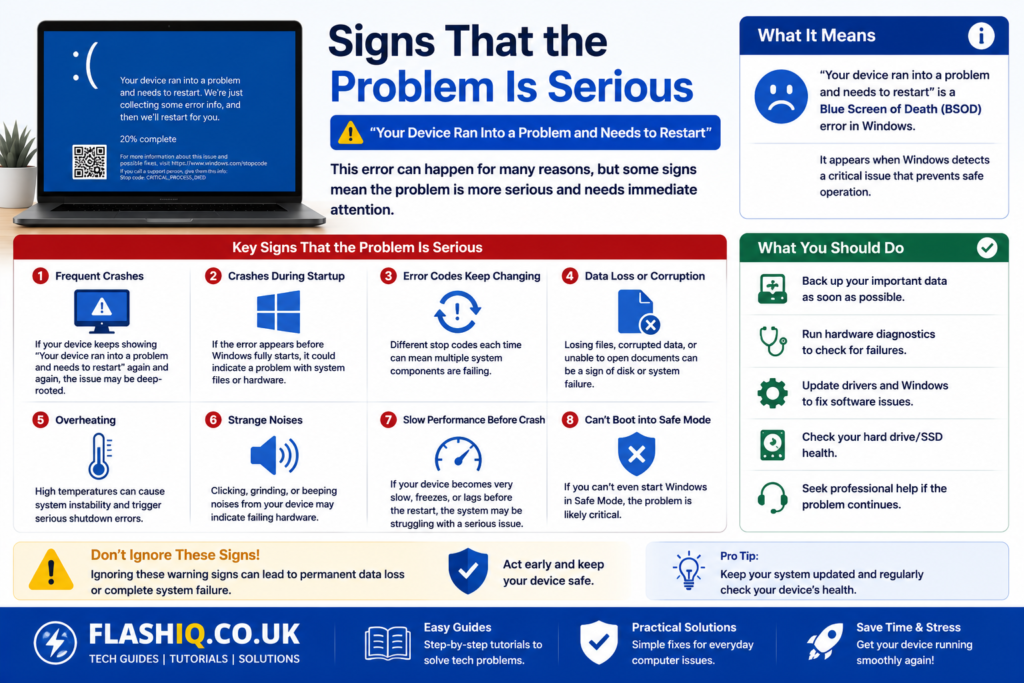
Frequent Blue Screens
If your device ran into a problem and needs to restart appears several times every day, hardware testing becomes more important.
Boot Loops
Sometimes Windows restarts repeatedly without reaching the desktop.
Random Freezing
Unexpected freezes before the blue screen often indicate driver or memory issues.
Error Codes
The blue screen usually includes stop codes such as:
- MEMORY_MANAGEMENT
- SYSTEM_SERVICE_EXCEPTION
- CRITICAL_PROCESS_DIED
- IRQL_NOT_LESS_OR_EQUAL
- PAGE_FAULT_IN_NONPAGED_AREA
These stop codes provide clues about why your device ran into a problem and needs to restart occurred.
Comparison Table Best Software to Help Fix “Your Device Ran Into a Problem and Needs to Restart”
| Software | Best For | Key Features | Free Version | Ease of Use | Overall Rating |
|---|---|---|---|---|---|
| Microsoft Windows Memory Diagnostic | Detecting faulty RAM | Built-in RAM testing, automatic scans, boot diagnostics | Yes | Very Easy | ⭐⭐⭐⭐⭐ |
| CrystalDiskInfo | SSD & HDD health monitoring | SMART analysis, drive health reports, temperature monitoring | Yes | Easy | ⭐⭐⭐⭐⭐ |
| BlueScreenView | Reading BSOD crash logs | Displays dump files, identifies crash drivers, lightweight | Yes | Easy | ⭐⭐⭐⭐☆ |
| Driver Booster | Updating outdated drivers | Automatic driver updates, backup before updates, large driver database | Free & Paid | Very Easy | ⭐⭐⭐⭐☆ |
| DISM & System File Checker (SFC) | Repairing Windows system files | Built into Windows, repairs corrupted files, restores system integrity | Yes | Moderate | ⭐⭐⭐⭐⭐ |
| Software | Best For | Key Features | Free Version | Ease of Use | Overall Rating |
|---|---|---|---|---|---|
| MemTest86 | Advanced RAM diagnostics | Bootable memory testing, detailed reports, detects hardware memory faults | Yes | Moderate | ⭐⭐⭐⭐⭐ |
| HWiNFO | Hardware monitoring | Real-time CPU, GPU, motherboard, temperature, voltage, and sensor monitoring | Yes | Moderate | ⭐⭐⭐⭐⭐ |
| Malwarebytes | Malware removal | Detects malware, ransomware, spyware, and unwanted programs that may cause system instability | Yes | Easy | ⭐⭐⭐⭐☆ |
| WinDbg Preview | BSOD crash analysis | Reads memory dump files, advanced debugging tools, identifies crash causes | Yes | Advanced | ⭐⭐⭐⭐☆ |
| EaseUS Partition Master | Disk and partition management | Disk health checks, partition repair, cloning, and drive optimization | Free & Paid | Easy | ⭐⭐⭐⭐☆ |
Feature Comparison Table
| Feature | Windows Memory Diagnostic | CrystalDiskInfo | BlueScreenView | Driver Booster | DISM & SFC | MemTest86 | HWiNFO | Malwarebytes | WinDbg Preview | EaseUS Partition Master |
|---|---|---|---|---|---|---|---|---|---|---|
| RAM Testing | ✅ | ❌ | ❌ | ❌ | ❌ | ✅ | ❌ | ❌ | ❌ | ❌ |
| Drive Health Monitoring | ❌ | ✅ | ❌ | ❌ | ❌ | ❌ | Limited | ❌ | ❌ | ✅ |
| Driver Updates | ❌ | ❌ | ❌ | ✅ | ❌ | ❌ | ❌ | ❌ | ❌ | ❌ |
| BSOD Analysis | ❌ | ❌ | ✅ | ❌ | ❌ | ❌ | Limited | ❌ | ✅ | ❌ |
| Repair System Files | ❌ | ❌ | ❌ | ❌ | ✅ | ❌ | ❌ | ❌ | ❌ | ❌ |
| Malware Detection | ❌ | ❌ | ❌ | ❌ | ❌ | ❌ | ❌ | ✅ | ❌ | ❌ |
| Hardware Monitoring | ❌ | Limited | ❌ | ❌ | ❌ | ❌ | ✅ | ❌ | ❌ | Limited |
| Beginner Friendly | ✅ | ✅ | ✅ | ✅ | Moderate | Moderate | Moderate | ✅ | Advanced | ✅ |
Pricing Comparison Table
| Software | Free Plan | Paid Version | Starting Price* | Best For |
|---|---|---|---|---|
| Windows Memory Diagnostic | Yes | No | Free | RAM testing |
| CrystalDiskInfo | Yes | No | Free | Disk monitoring |
| BlueScreenView | Yes | No | Free | BSOD log viewing |
| Driver Booster | Yes | Yes | Around $24.95/year | Driver updates |
| DISM & SFC | Yes | No | Free | Windows repair |
| MemTest86 | Yes | Yes | Free / Commercial editions | Advanced memory testing |
| HWiNFO | Yes | Yes | Free / Professional license | Hardware monitoring |
| Malwarebytes | Yes | Yes | Around $44.99/year | Malware protection |
| WinDbg Preview | Yes | No | Free | Crash debugging |
| EaseUS Partition Master | Yes | Yes | Around $49.95/year | Disk management |
*Prices are approximate and may vary by region or promotional offers.
How to Choose the Right Software
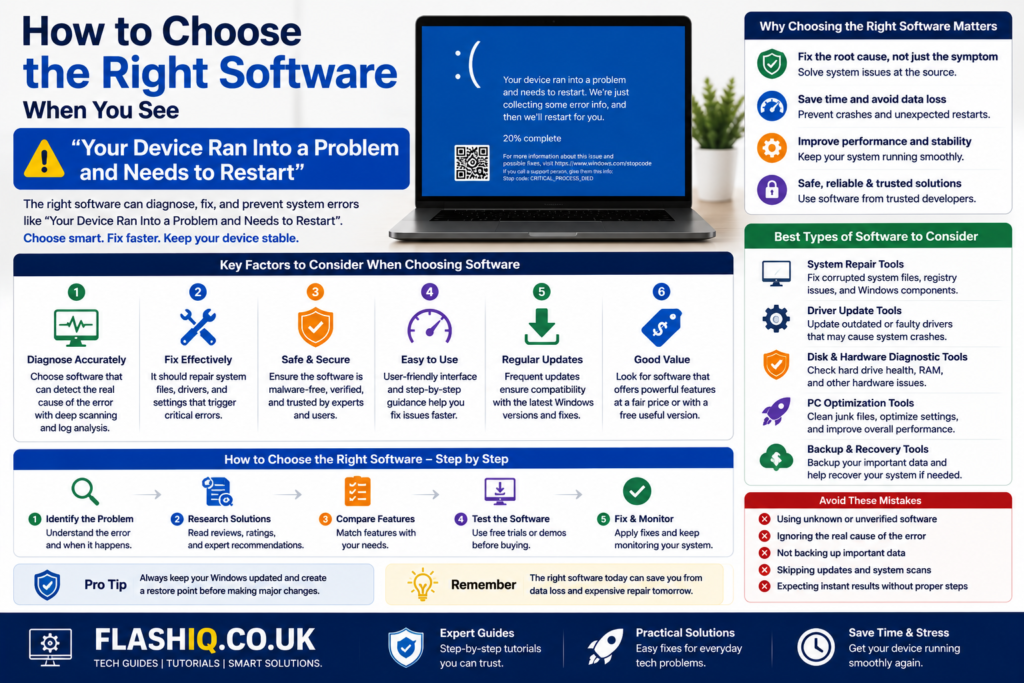
Choosing the right tool depends on what is causing your device ran into a problem and needs to restart. Start by identifying when the error occurs. If the blue screen appears after installing new hardware or software, investigate drivers first. If crashes happen randomly, test your RAM and storage devices.
For beginners, built-in Windows tools such as Windows Memory Diagnostic and DISM with SFC are excellent starting points because they are free and already included with Windows. They can repair common problems without requiring additional downloads.
If the issue continues after basic troubleshooting, use CrystalDiskInfo to check storage health, HWiNFO to monitor hardware temperatures, and MemTest86 for more comprehensive memory testing. Users who frequently experience BSOD errors can also review crash logs using BlueScreenView or WinDbg Preview to identify the exact driver or system component responsible.
Selecting the correct software based on your symptoms saves time and avoids unnecessary repairs.
Our Recommendation
If you only encounter your device ran into a problem and needs to restart occasionally, begin with the built-in Windows repair utilities. Run System File Checker (SFC), DISM, Windows Memory Diagnostic, and install the latest Windows and driver updates.
For recurring blue screen errors, combine CrystalDiskInfo with HWiNFO to monitor your storage and hardware health. If memory problems are suspected, MemTest86 provides one of the most reliable diagnostic tests available.
Advanced users or IT professionals should use BlueScreenView and WinDbg Preview to analyze crash dump files and determine the exact source of the problem. This combination provides a structured approach to diagnosing both software and hardware issues while minimizing unnecessary troubleshooting.
Conclusion
Although your device ran into a problem and needs to restart can seem alarming, it is often Windows’ way of protecting your system from further damage. In many cases, the problem can be traced to outdated drivers, corrupted system files, faulty memory, storage issues, or incompatible software.
By following a step-by-step troubleshooting process and using reliable diagnostic tools, most users can resolve the error without reinstalling Windows or replacing their computer. Regular maintenance—such as updating drivers, monitoring hardware health, scanning for malware, and installing Windows updates—can also reduce the chances of seeing your device ran into a problem and needs to restart again in the future.
Frequently Asked Questions (FAQs)
1. What does “your device ran into a problem and needs to restart” mean?
It means Windows encountered a critical system error (Blue Screen of Death) and automatically restarted to prevent further damage.
2. Is this error caused by a virus?
Sometimes, but not usually. Driver issues, corrupted system files, hardware failures, and Windows updates are much more common causes.
3. Can faulty RAM cause this error?
Yes. Defective memory modules are one of the leading reasons for recurring BSOD errors.
4. Will reinstalling Windows fix the problem?
It may resolve software-related issues, but it will not fix faulty hardware such as bad RAM or a failing SSD.
5. How can I find out what caused the blue screen?
You can review Windows dump files using BlueScreenView or WinDbg Preview to identify the specific stop code or failing driver.
6. Should I update my drivers?
Yes. Keeping drivers up to date often resolves compatibility issues that trigger blue screen errors.
7. Can overheating trigger this problem?
Yes. Excessive CPU or GPU temperatures can lead to system instability and unexpected crashes.
8. How do I prevent this error from happening again?
Maintain Windows updates, update drivers regularly, monitor hardware health, scan for malware, and back up important data frequently.
Quick Bio
About the Author
The FlashIQ editorial team specializes in creating practical technology guides, Windows troubleshooting tutorials, software comparisons, and digital productivity resources. Our goal is to simplify complex technical problems with accurate, easy-to-follow solutions that help users keep their devices running smoothly.