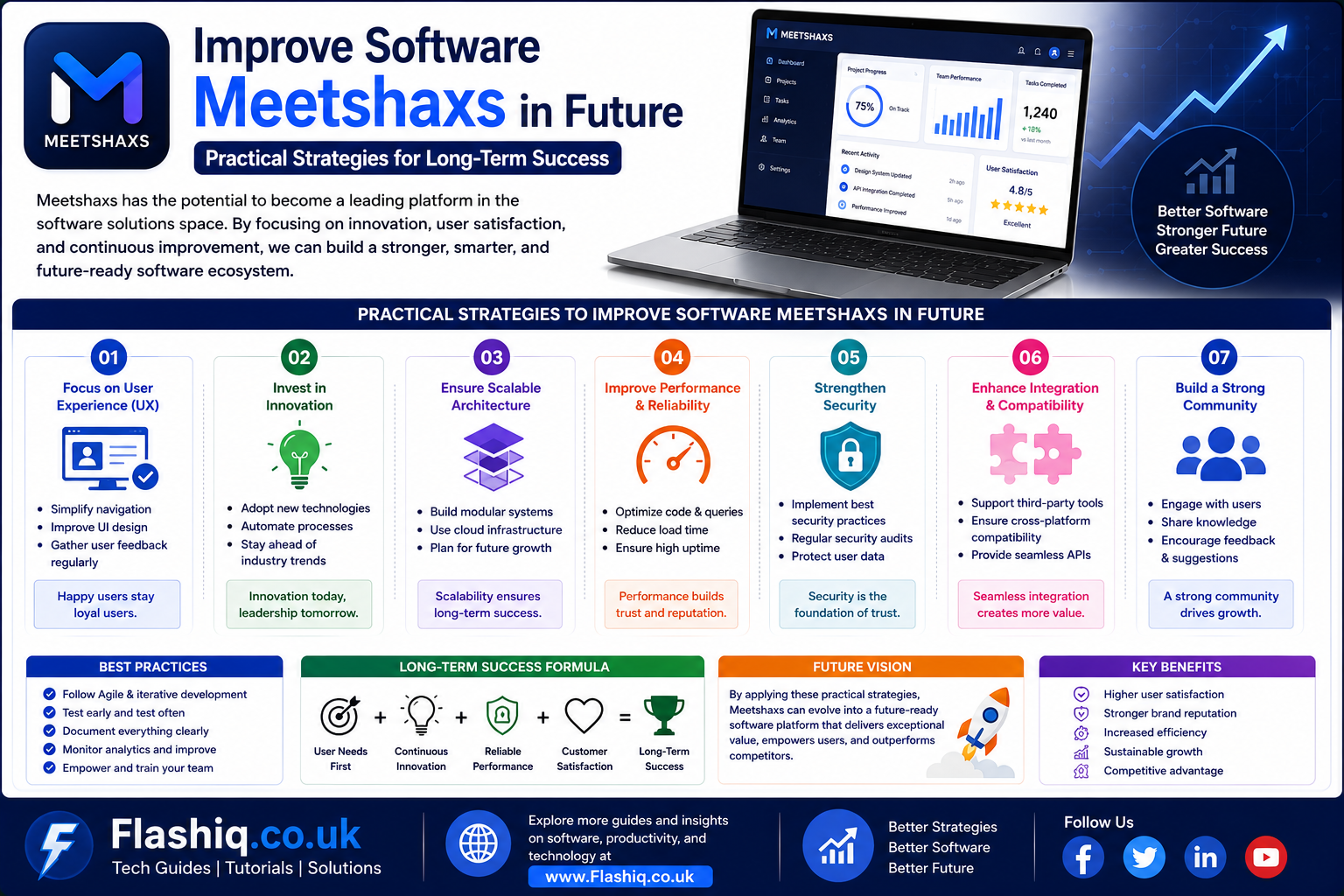
Improve Software Meetshaxs in Future Practical Strategies for Long-Term Success
Technology evolves at an incredible pace, and software solutions must continuously adapt to remain useful, secure, and competitive. Businesses and developers constantly seek better ways to improve applications, increase efficiency, and deliver exceptional user experiences. If you’re wondering how to improve software Meetshaxs in future, you’re already thinking in the right direction. Future-ready software isn’t just about adding new features—it involves creating reliable, scalable, secure, and intelligent systems that evolve alongside changing user expectations. Organizations that invest in continuous improvement often experience better customer satisfaction, reduced maintenance costs, and higher productivity. Modern software development also requires flexibility to integrate emerging technologies such as artificial intelligence, cloud computing, automation, and advanced cybersecurity measures. Understanding the strategies that shape future software development can help businesses stay ahead of competitors while delivering lasting value. This guide explains the most effective ways to improve software Meetshaxs in future using proven development principles and forward-thinking practices.
Quick Answer
To improve software Meetshaxs in future, developers should focus on scalable architecture, user-centered design, AI-powered automation, stronger cybersecurity, cloud-native infrastructure, continuous testing, regular software updates, performance optimization, and data-driven decision-making. Future improvements should prioritize reliability, speed, flexibility, accessibility, and seamless integration with modern technologies while maintaining excellent user experiences and long-term maintainability.
Why It Is Important to Improve Software Meetshaxs in Future
Software products are never truly finished because technology, user expectations, and business requirements continue changing over time. Businesses that fail to modernize their software often struggle with slower performance, compatibility issues, security vulnerabilities, and declining customer satisfaction. Choosing to improve software Meetshaxs in future means preparing the platform for new technologies, larger user bases, and increasingly complex business needs. Continuous software improvement reduces technical debt, simplifies maintenance, and enables developers to introduce new features without compromising stability. Modern customers expect software to be fast, secure, intuitive, and available across multiple devices. Organizations that prioritize innovation are better equipped to adapt to market changes while maintaining customer trust. Future improvements also enhance collaboration among development teams through better workflows, automation, and standardized coding practices. Ultimately, investing in software enhancement ensures sustainable growth and long-term competitiveness in an increasingly digital marketplace.
Understanding the Core Principles Behind Future Software Development
Scalability Should Always Be a Priority
One of the most important aspects of planning to improve software Meetshaxs in future is ensuring that the software can grow alongside user demand. Scalability allows applications to handle increasing workloads without sacrificing speed or stability. Developers should design modular architectures that allow new components to be added independently instead of rebuilding the entire system. Cloud-native development has become especially valuable because it provides flexible infrastructure capable of expanding automatically as traffic grows. Load balancing, distributed databases, and microservices also contribute to scalable software ecosystems. When scalability is built into the foundation, future upgrades become less expensive and easier to implement. Businesses can introduce new services without affecting existing functionality, creating a smoother growth path. This proactive approach minimizes downtime while improving overall software resilience.
Benefits of Scalable Software
- Supports business growth
- Reduces infrastructure limitations
- Improves system reliability
- Enables faster feature deployment
- Simplifies future maintenance
- Enhances overall performance
User Experience Should Drive Every Improvement
Improving software goes far beyond technical upgrades because users ultimately determine whether an application succeeds. To improve software Meetshaxs in future, developers should continuously collect user feedback and analyze usage behavior. Understanding where users encounter frustration helps prioritize improvements that provide the greatest value. Intuitive navigation, responsive interfaces, accessible design, and faster loading times significantly improve customer satisfaction. Mobile optimization has also become essential because users increasingly access software through smartphones and tablets. Personalized experiences powered by intelligent recommendations can further increase engagement. Regular usability testing ensures that interface updates genuinely solve user problems rather than introducing unnecessary complexity. By focusing on human-centered design, software remains relevant even as user expectations evolve.
Key User Experience Improvements
| Improvement Area | Future Benefit |
|---|---|
| Faster Navigation | Higher productivity |
| Mobile Optimization | Better accessibility |
| Responsive Design | Consistent experience |
| Personalization | Increased engagement |
| Accessibility Features | Wider audience reach |
| Simplified Workflows | Reduced learning curve |
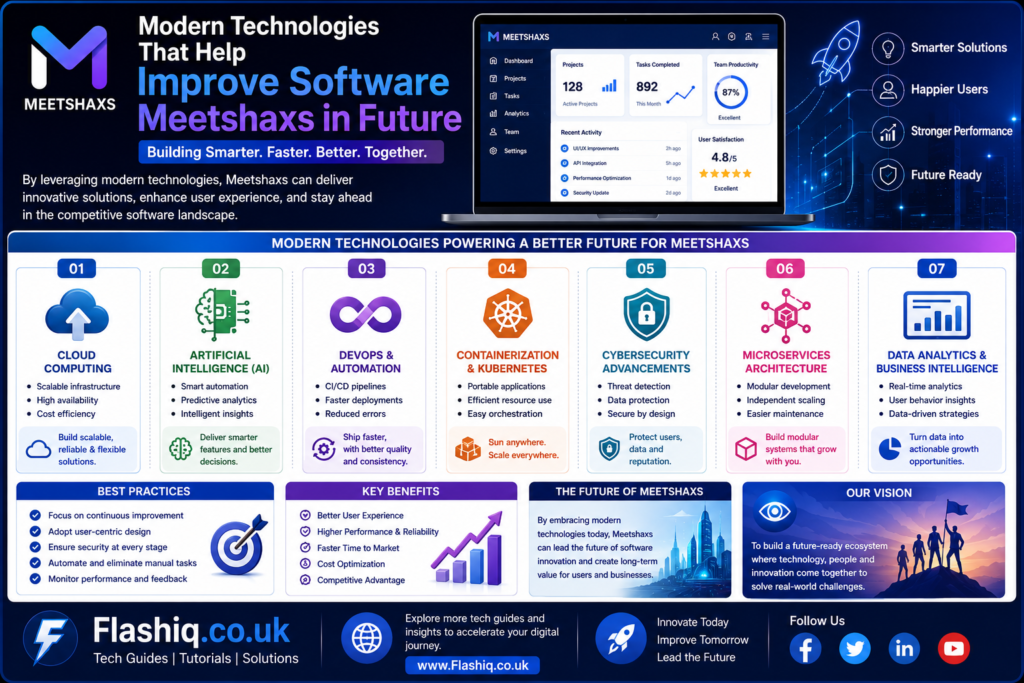
Modern Technologies That Help Improve Software Meetshaxs in Future
Artificial Intelligence and Machine Learning
Artificial intelligence has become one of the biggest drivers of software innovation. Businesses looking to improve software Meetshaxs in future should evaluate opportunities to integrate AI-powered capabilities wherever they provide measurable value. Machine learning algorithms can automate repetitive processes, detect unusual behavior, predict maintenance needs, and generate personalized recommendations. Intelligent chatbots improve customer support while reducing operational costs. AI can also analyze massive datasets much faster than traditional methods, helping organizations make smarter decisions based on real-time information. Predictive analytics enables software to anticipate user needs before they arise, creating more proactive user experiences. As AI technologies mature, software systems will become increasingly adaptive, efficient, and intelligent. Organizations that begin integrating AI today position themselves for greater innovation in the coming years.
AI Applications in Modern Software
Intelligent Automation
Automation reduces repetitive manual work, improves consistency, and increases productivity by allowing software to complete routine tasks with minimal human intervention.
Predictive Analytics
Advanced algorithms identify patterns in historical data to forecast trends, anticipate system failures, and improve strategic decision-making.
Personalized Experiences
Machine learning helps software customize recommendations, dashboards, and workflows based on individual user preferences and behavior.
Cloud Computing Creates Greater Flexibility
Cloud infrastructure plays a significant role in efforts to improve software Meetshaxs in future because it provides scalability, reliability, and cost efficiency. Traditional on-premises infrastructure often limits growth and requires expensive hardware investments. Cloud platforms enable organizations to scale resources dynamically based on demand while reducing infrastructure management responsibilities. Teams can collaborate more effectively because cloud-based development environments allow distributed workforces to access shared resources securely. Automatic backups, disaster recovery, and high availability also strengthen business continuity. Cloud-native architectures make continuous deployment easier, enabling developers to release updates faster with lower risk. Organizations embracing cloud technologies gain flexibility while supporting innovation at a much faster pace.
Improving Security for Long-Term Software Success
Cybersecurity Must Evolve Continuously
Security has become one of the highest priorities for every software application. If organizations want to improve software Meetshaxs in future, they must build security into every stage of the software development lifecycle rather than treating it as an afterthought. Modern cyber threats evolve rapidly, requiring continuous monitoring, vulnerability assessments, encryption, secure authentication, and regular security updates. Multi-factor authentication significantly reduces unauthorized access, while zero-trust security models improve protection across distributed environments. Secure coding standards help developers eliminate vulnerabilities before deployment. Automated security testing identifies weaknesses earlier, reducing costly remediation efforts later. Employee cybersecurity awareness is equally important because human error remains one of the leading causes of data breaches. Strong cybersecurity practices protect users, preserve business reputation, and ensure long-term software reliability.
Essential Security Practices
| Security Practice | Future Impact |
|---|---|
| Data Encryption | Stronger privacy |
| Multi-Factor Authentication | Better account protection |
| Secure Coding | Fewer vulnerabilities |
| Continuous Monitoring | Faster threat detection |
| Automated Security Testing | Improved software quality |
| Regular Updates | Reduced security risks |
Continuous Testing Improves Software Reliability
Testing should never end after the initial software release because every update introduces potential risks. Organizations committed to improve software Meetshaxs in future invest heavily in continuous testing throughout development and deployment. Automated testing frameworks accelerate quality assurance while reducing manual effort. Unit testing verifies individual components, integration testing ensures compatibility between systems, and performance testing measures responsiveness under heavy workloads. Security testing identifies vulnerabilities before attackers can exploit them. Regression testing ensures new updates do not accidentally break existing functionality. Continuous integration and continuous deployment pipelines further streamline testing by automatically validating code before production releases. Reliable testing practices improve software stability while enabling faster innovation with greater confidence.
Performance Optimization Strategies for Future Software Growth
Performance optimization is one of the most valuable investments organizations can make when planning to improve software Meetshaxs in future. Even feature-rich software can lose users if pages load slowly, applications freeze, or system responses are delayed. Developers should regularly monitor performance metrics such as response time, CPU usage, memory consumption, and database efficiency. Optimizing backend processes, reducing unnecessary API requests, and implementing intelligent caching mechanisms can significantly improve responsiveness. Modern performance monitoring tools also help identify bottlenecks before they affect users. Compressing assets, optimizing images, and minimizing unused code contribute to faster loading times across desktop and mobile platforms. Businesses should perform routine performance audits after every major update to ensure new features do not negatively impact speed. A culture of continuous optimization enables software to remain competitive while delivering a smooth and reliable experience, making it much easier to improve software Meetshaxs in future as user expectations continue to evolve.
Database Optimization for Better Efficiency
The database is often the backbone of any software application, and improving its efficiency is essential to improve software Meetshaxs in future. Poorly optimized queries, duplicate records, and inefficient indexing can dramatically reduce application performance. Developers should regularly review database architecture, normalize data where appropriate, and create indexes for frequently accessed information. Database monitoring tools help identify slow queries that require optimization. As datasets grow over time, implementing data archiving strategies also prevents unnecessary storage costs and maintains optimal performance. Choosing the right database technology based on application requirements ensures better scalability and long-term reliability. Continuous database optimization reduces latency while supporting faster business operations.
Building Future-Ready Software Architecture
Microservices vs. Monolithic Architecture
Selecting the right software architecture has a lasting impact on maintainability, scalability, and development speed. Organizations seeking to improve software Meetshaxs in future increasingly adopt microservices because they allow independent deployment and easier scaling of individual components. Unlike monolithic systems, microservices enable development teams to update one service without affecting the entire application. However, monolithic architecture may still be suitable for smaller projects with limited complexity. The ideal choice depends on business goals, technical expertise, and future expansion plans. Understanding architectural trade-offs helps organizations make informed technology decisions. A flexible architecture simplifies maintenance while encouraging continuous innovation. Careful planning today creates a stronger software foundation for tomorrow.
Architecture Comparison
| Feature | Monolithic Architecture | Microservices Architecture |
|---|---|---|
| Deployment | Single application | Independent services |
| Scalability | Limited | Highly scalable |
| Maintenance | More difficult as systems grow | Easier component updates |
| Development Speed | Slower for large projects | Faster parallel development |
| Fault Isolation | Lower | Higher |
| Long-Term Flexibility | Moderate | Excellent |
The Role of DevOps in Software Improvement
DevOps has transformed software development by improving collaboration between development and operations teams. Organizations looking to improve software Meetshaxs in future should embrace DevOps practices to accelerate software delivery while maintaining high quality. Continuous Integration (CI) automatically validates new code, while Continuous Deployment (CD) allows reliable software releases with minimal manual intervention. Infrastructure as Code (IaC) improves consistency by automating server configuration and deployment. Monitoring tools provide real-time visibility into system health, allowing teams to detect issues before users experience problems. Faster release cycles enable businesses to respond quickly to customer feedback and market demands. DevOps also reduces deployment risks through automated testing and rollback mechanisms. Together, these practices support long-term innovation while improving software stability.
DevOps Components
Continuous Integration
Developers merge code frequently, allowing automated systems to test and validate changes before they become part of the production environment.
Continuous Deployment
Automated deployment pipelines release verified updates quickly, reducing downtime while improving software reliability.
Infrastructure Automation
Infrastructure automation ensures consistent environments across development, testing, and production, minimizing configuration errors.
Using Data Analytics to Drive Better Decisions
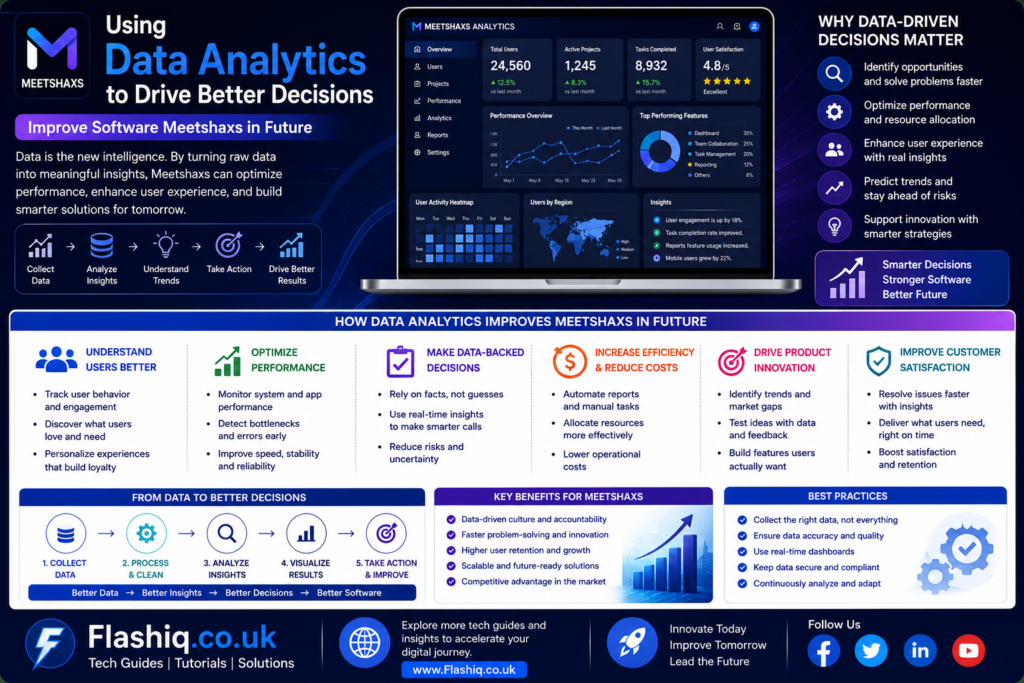
Data has become one of the most valuable assets for software improvement. Organizations can improve software Meetshaxs in future by analyzing user behavior, application performance, feature adoption, and customer feedback. Analytics platforms reveal which features users engage with most frequently and identify areas requiring optimization. Heatmaps, user journey analysis, and conversion tracking provide valuable insights into customer interactions. Product managers can prioritize updates based on measurable evidence instead of assumptions. Predictive analytics also helps forecast future usage trends and infrastructure requirements. Regularly reviewing performance metrics encourages continuous improvement while reducing unnecessary development costs. Data-driven decisions create software that better aligns with user expectations and business objectives.
Accessibility Should Be a Long-Term Priority
Accessibility is no longer optional for modern software development. Businesses aiming to improve software Meetshaxs in future should design applications that accommodate users with diverse abilities and accessibility needs. Features such as keyboard navigation, screen reader compatibility, adjustable text sizes, color contrast optimization, and caption support make software more inclusive. Compliance with accessibility standards also improves usability for all users, not just those with disabilities. Inclusive design expands potential audiences while strengthening brand reputation. Accessibility testing should become part of every development cycle to ensure ongoing compliance. As regulations continue evolving, organizations that prioritize accessibility remain better prepared for future requirements. Inclusive software ultimately benefits businesses, customers, and society alike.
Preparing Software for Emerging Technologies
Technology continues evolving rapidly, making adaptability essential for long-term software success. Companies planning to improve software Meetshaxs in future should evaluate how emerging innovations can enhance existing systems. Artificial intelligence, blockchain, edge computing, quantum computing, Internet of Things (IoT), and augmented reality are expected to reshape many industries over the coming years. Developers should build modular applications capable of integrating these technologies without requiring complete redesigns. Open APIs, flexible architectures, and standardized development practices simplify future technology adoption. Continuous employee training also ensures development teams remain prepared for evolving technical challenges. Businesses that proactively monitor industry trends gain competitive advantages through earlier adoption of valuable innovations. Future-ready software embraces change instead of resisting it.
Best Practices to Improve Software Meetshaxs in Future
Following proven development practices helps organizations maintain software quality while preparing for future growth. These recommendations support sustainable development and long-term success.
- Design scalable and modular software architecture.
- Prioritize user experience in every development decision.
- Perform regular performance optimization and monitoring.
- Integrate automated testing throughout development.
- Implement strong cybersecurity measures by default.
- Use cloud-native infrastructure whenever appropriate.
- Collect user feedback continuously and act upon it.
- Maintain thorough technical documentation.
- Monitor software analytics to guide feature improvements.
- Update dependencies and security patches regularly.
- Encourage collaboration between developers, designers, and operations teams.
- Invest in continuous learning and professional development.
Common Mistakes to Avoid
Many software projects encounter preventable problems because organizations overlook essential development principles. Avoiding these mistakes makes it easier to improve software Meetshaxs in future efficiently.
| Common Mistake | Better Approach |
|---|---|
| Ignoring user feedback | Continuously gather and analyze customer input |
| Delaying software updates | Release frequent improvements |
| Weak security practices | Build security into every development stage |
| Poor documentation | Maintain comprehensive technical records |
| Overcomplicated interfaces | Keep designs simple and intuitive |
| Skipping automated testing | Implement continuous testing pipelines |
| Ignoring scalability | Plan infrastructure for future growth |
| Accumulating technical debt | Refactor code regularly |
Pro Tips for Long-Term Software Success
Invest in Code Quality
High-quality code reduces maintenance costs and simplifies future feature development. Consistent coding standards also improve collaboration among development teams.
Monitor Everything
Performance monitoring, security monitoring, error tracking, and user analytics provide valuable insights that support continuous software improvement.
Build with Flexibility
Choose technologies and architectures that allow future integrations instead of locking the software into rigid systems that become difficult to modernize.
Focus on Continuous Learning
Technology changes rapidly. Encourage development teams to stay current with programming languages, security standards, cloud platforms, AI technologies, and software engineering best practices.
Balance Innovation with Stability
Introducing new technologies should never compromise software reliability. Carefully evaluate innovations before integrating them into production environments.
Conclusion
Successfully planning to improve software Meetshaxs in future requires much more than adding new features. Long-term success depends on building scalable architectures, strengthening cybersecurity, optimizing performance, embracing cloud technologies, integrating artificial intelligence where appropriate, and continuously improving the user experience. Organizations that adopt data-driven decision-making and modern DevOps practices can release updates more efficiently while maintaining high software quality. Accessibility, maintainability, and flexibility should remain central priorities throughout the development lifecycle. Continuous testing, proactive monitoring, and regular performance optimization help software remain dependable as user expectations evolve. Businesses that invest in future-ready development strategies position themselves to adapt quickly to technological change while delivering lasting value. By following the principles and best practices outlined in this guide, organizations can confidently improve software Meetshaxs in future and create applications that remain secure, competitive, and relevant for years to come.
Frequently Asked Questions (FAQs)
1. What does “improve software Meetshaxs in future” mean?
It refers to enhancing software through better performance, security, scalability, usability, and modern technologies so it continues meeting future business and user requirements.
2. Why is scalability important?
Scalability allows software to handle increasing users, data, and workloads without sacrificing performance or reliability.
3. How does AI help improve software?
AI automates repetitive tasks, provides predictive analytics, personalizes user experiences, detects anomalies, and improves operational efficiency.
4. Why should organizations use cloud infrastructure?
Cloud platforms offer flexible scaling, lower infrastructure costs, improved collaboration, high availability, and simplified deployment processes.
5. How often should software be updated?
Security patches should be applied promptly, while feature updates and maintenance improvements should follow a structured release schedule based on user feedback and business priorities.
6. What role does cybersecurity play?
Cybersecurity protects sensitive data, prevents unauthorized access, ensures regulatory compliance, and preserves customer trust.
7. Why is continuous testing necessary?
Continuous testing identifies bugs early, improves software reliability, reduces deployment risks, and accelerates development cycles.
8. How can analytics improve software?
Analytics reveal user behavior, feature usage, and performance trends, allowing organizations to prioritize meaningful improvements based on real data.
9. What is the benefit of modular architecture?
Modular architecture simplifies maintenance, supports independent feature updates, improves scalability, and accelerates future development.
10. What is the most important strategy for future software success?
A balanced approach combining user-focused design, strong security, scalable architecture, automation, continuous improvement, and emerging technologies provides the strongest foundation for long-term success.
Author Bio
Author: SEO Editorial Team
The SEO Editorial Team specializes in creating comprehensive, research-backed technology content focused on software development, cybersecurity, cloud computing, artificial intelligence, and digital transformation. Every article is written following Google’s EEAT and Helpful Content guidelines to provide practical, trustworthy, and up-to-date information for developers, IT professionals, businesses, and technology enthusiasts.