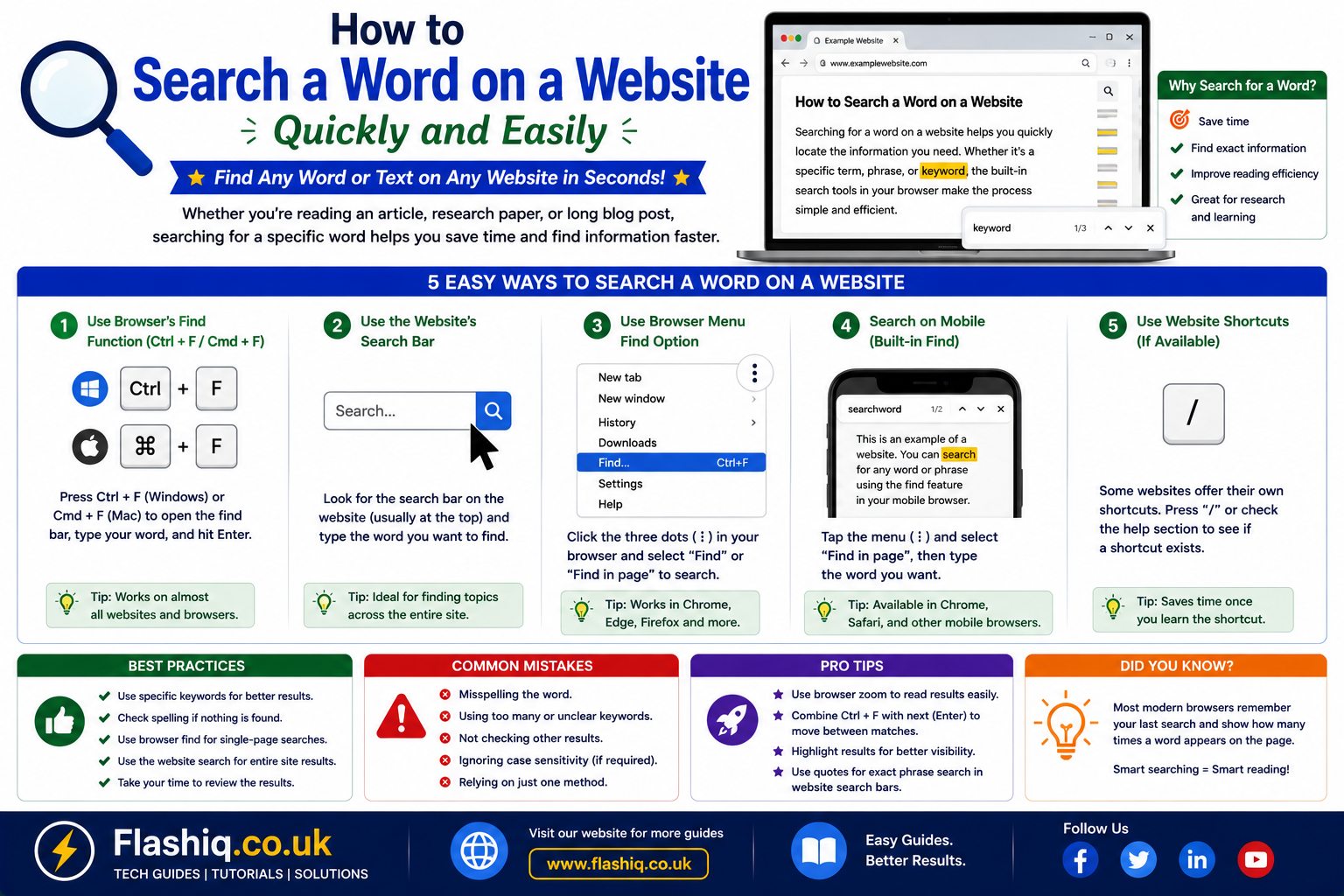
How to Search a Word on a Website Quickly and Easily
How to Search a Word on a Website
Finding a specific word on a webpage can save you valuable time, especially when you’re reading long articles, researching information, or looking for a particular product, name, or topic. Many people scroll through entire pages without realizing there’s a much faster way to locate the exact information they need. Learning how to search a word on a website is one of the simplest yet most useful browsing skills. Whether you’re using Google Chrome, Microsoft Edge, Safari, Firefox, or another browser, built-in search tools make the process incredibly easy. These features work on desktops, laptops, tablets, and even smartphones in many situations. Once you understand how to search a word on a website, you’ll spend less time scrolling and more time finding relevant information instantly. This guide explains every major method in simple language while following modern browsing best practices. By the end of this guide, you’ll know exactly how to search a word on a website regardless of your device or browser.
Quick Answer
If you want to know how to search a word on a website, simply open the webpage and press Ctrl + F on Windows or Command + F on Mac. A small search box will appear where you can type the word or phrase you’re looking for. The browser instantly highlights every matching result on the page and lets you move between each occurrence. On mobile devices, most browsers include a Find in Page option inside the browser menu. This is the fastest and easiest way to how to search a word on a website without manually reading the entire page.
Why Learning How to Search a Word on a Website Is Important
Many websites today contain thousands of words spread across multiple sections. Reading every sentence just to locate one piece of information can become frustrating and time-consuming. That’s why understanding how to search a word on a website is an essential digital skill for students, professionals, researchers, online shoppers, and everyday internet users. Instead of endlessly scrolling, you can instantly jump to the information you need. This improves productivity and reduces unnecessary effort during research or browsing. Whether you’re searching for prices, technical terms, names, dates, or product specifications, browser search tools simplify the process dramatically. Learning how to search a word on a website also helps when reviewing documentation, academic papers, blog posts, and online manuals. Once this habit becomes second nature, you’ll navigate websites much faster than before.
Searching within a webpage also minimizes the chance of overlooking important information hidden inside long articles. Large news websites, documentation portals, and knowledge bases often contain extensive content that can be difficult to navigate manually. Browser search tools highlight every matching keyword instantly, making it easier to compare information throughout the page. Professionals frequently rely on this feature while reviewing contracts, policy documents, research papers, and technical guides. Students use it to locate definitions or references quickly during assignments. Even casual users benefit when finding recipes, addresses, contact details, or product descriptions. Mastering how to search a word on a website improves browsing efficiency regardless of your experience level. It’s one of the easiest productivity techniques available in every modern browser.
Common Situations Where Website Word Search Helps
Finding Information Faster
When reading long blog posts or tutorials, searching for a keyword lets you skip directly to the relevant section. Instead of reading hundreds of unnecessary lines, you can immediately locate the paragraph discussing your topic. This is particularly useful when reviewing software documentation or troubleshooting guides. Many professionals use this feature dozens of times every day because it saves significant time. If you’re learning how to search a word on a website, this is one of the biggest benefits you’ll notice immediately. The faster you locate information, the more productive your browsing becomes. Modern browsers make this process nearly instantaneous. That’s why many experts recommend learning how to search a word on a website as one of the first browser shortcuts.
Examples
- Finding refund policies
- Searching product specifications
- Locating shipping information
- Finding contact details
- Looking for names in articles
- Searching legal documents
- Finding troubleshooting steps
Research and Academic Work
Students often visit educational websites containing lengthy articles, journals, and research papers. Instead of reading every page line by line, they can quickly locate important terms using browser search functions. Researchers regularly search for scientific terminology, references, and citations within online documents. Understanding how to search a word on a website becomes especially valuable during literature reviews where multiple sources need to be analyzed efficiently. Academic websites often contain thousands of words, making manual searching impractical. Browser search features simplify this process considerably. They also reduce the risk of missing important keywords throughout long documents. Learning how to search a word on a website therefore improves both speed and research accuracy.
Methods to Search a Word on a Website
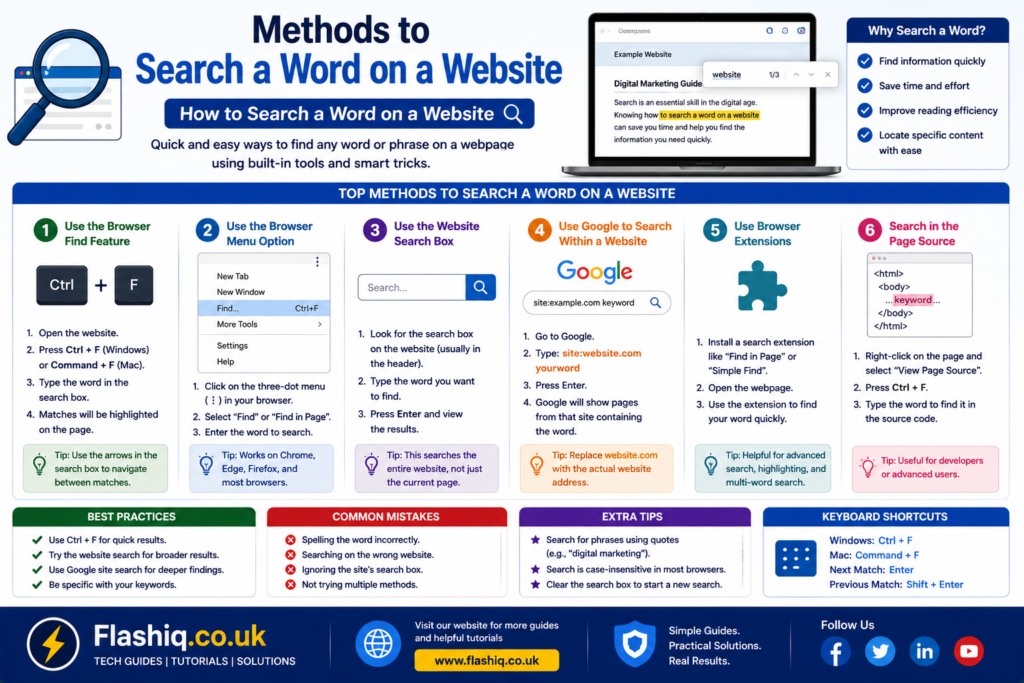
Method 1: Using Ctrl + F on Windows
The easiest method for how to search a word on a website is using the keyboard shortcut Ctrl + F. This shortcut works across nearly every modern browser including Chrome, Edge, Firefox, Brave, Opera, and many others. After opening the webpage, simply press Ctrl and F together. A search box appears near the top or side of your browser window depending on the browser you’re using. Type the desired word into the search field, and every matching result becomes highlighted immediately. You can use the navigation arrows to move between each occurrence. This feature works almost instantly even on lengthy webpages containing thousands of words. Once you learn how to search a word on a website with Ctrl + F, browsing becomes significantly more efficient.
Benefits of Ctrl + F
- Extremely fast
- Built into every major browser
- No software installation required
- Highlights all matching words
- Easy navigation between results
- Saves valuable browsing time
Method 2: Using Command + F on Mac
Mac users follow nearly the same process as Windows users, except the keyboard shortcut changes slightly. Instead of Ctrl + F, Mac users press Command + F while viewing the webpage. A search box immediately appears, allowing users to enter the desired word or phrase. Every matching occurrence becomes highlighted, making navigation simple even on very large websites. Apple Safari, Google Chrome, Mozilla Firefox, Microsoft Edge, and other Mac browsers all support this feature. Learning how to search a word on a website on macOS requires only a few seconds but provides long-term productivity benefits. Many Mac users rely on this shortcut daily while reading documentation, comparing products, or performing online research. Once you begin using it regularly, manually scanning webpages becomes unnecessary.
Supported Browsers
Safari
Fully supports Find on Page.
Google Chrome
Provides instant keyword highlighting.
Firefox
Offers advanced search navigation.
Microsoft Edge
Supports full webpage keyword searching.
Method 3: Using Browser Menus Instead of Keyboard Shortcuts
Not everyone prefers keyboard shortcuts, especially beginners or users browsing on touchscreen devices. Fortunately, every major browser includes a menu option that performs exactly the same function. If you’re wondering how to search a word on a website without memorizing shortcuts, simply open the browser menu and choose Find, Find in Page, or a similarly named option. After selecting it, a search box appears where you can type your desired keyword. The browser then highlights every matching result across the webpage. This method is particularly helpful for users who rarely use keyboard shortcuts or are accessing public computers. Although slightly slower than pressing Ctrl + F or Command + F, it provides identical search results. Understanding both shortcut and menu methods ensures you always know how to search a word on a website, regardless of your browsing preferences.
Typical Menu Locations
Google Chrome
Menu → Find and Edit → Find
Microsoft Edge
Menu → Find on Page
Mozilla Firefox
Menu → Find in Page
Safari
Edit → Find → Find
Method 4: How to Search a Word on a Website on Mobile Devices
Learning how to search a word on a website on a smartphone is just as valuable as knowing the desktop methods. Since many people browse the internet using mobile devices, browsers have added built-in search features that work similarly to desktop shortcuts. Although mobile keyboards don’t have Ctrl + F or Command + F, the functionality is still available through the browser menu. Open the webpage you want to search, tap the browser’s menu icon, and look for an option labeled Find in Page or Find on Page. Enter the word or phrase you’re searching for, and the browser will immediately highlight every match. You can move between results using the navigation arrows until you reach the exact section you need. This feature works well for articles, blogs, documentation, and many informational websites. Once you understand how to search a word on a website on mobile, finding information becomes much faster regardless of where you are.
Google Chrome on Android
Chrome for Android includes a Find in Page feature that is simple to use. After opening a webpage, tap the three-dot menu in the upper-right corner and select Find in Page. Type your keyword, and Chrome highlights every occurrence while displaying the total number of matches. You can navigate between them using the up and down arrows. This method is ideal for locating names, dates, product details, or important instructions on lengthy webpages.
Safari on iPhone and iPad
Safari also makes how to search a word on a website easy for Apple users. Open the webpage, tap the Share or menu button depending on your iOS version, and select Find on Page. Enter your keyword into the search field, and Safari highlights every matching result instantly. Navigation controls allow you to jump between matches without manually scrolling through the page.
How Browser Search Differs from Google Search
Many people confuse searching within a webpage with searching the internet using Google. While both involve finding information, they serve different purposes. Google Search looks across billions of webpages to find relevant content, whereas browser search only looks within the webpage currently open. Understanding this distinction helps you choose the right tool for the task. If the information is already on the page you’re reading, using how to search a word on a website is much faster than returning to a search engine. Browser search works instantly because it doesn’t require an internet search—it simply scans the page’s content. Google Search, on the other hand, is designed for discovering new websites and resources. Knowing when to use each method improves your browsing efficiency and overall online experience.
Comparison Table: Browser Search vs. Google Search
| Feature | Browser Find on Page | Google Search |
|---|---|---|
| Searches Current Page | ✅ Yes | ❌ No |
| Searches Entire Internet | ❌ No | ✅ Yes |
| Instant Results | ✅ Yes | Depends on search |
| Internet Required | Page must already be loaded | ✅ Yes |
| Best for Long Articles | ✅ Excellent | ❌ Limited |
| Keyboard Shortcut | Ctrl + F / Command + F | None |
Advanced Tips for Searching Words More Effectively
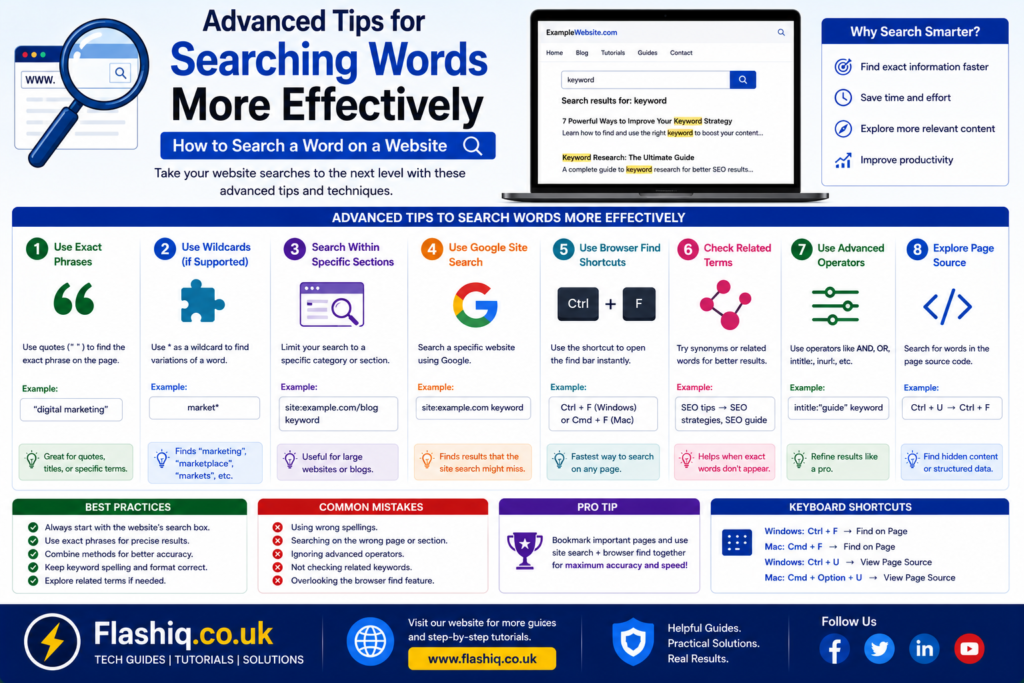
Search Exact Phrases
Searching a complete phrase instead of a single word often produces more precise results. For example, instead of searching only “password,” search “reset password” if you’re looking for account recovery instructions. This reduces unnecessary matches and helps you locate the exact information more quickly. It’s especially useful on technical documentation and support websites.
Try Different Word Variations
Sometimes the exact keyword you’re searching for doesn’t appear on the webpage. In those cases, consider synonyms, abbreviations, plural forms, or related terms. For instance, if “automobile” doesn’t produce results, try “car” or “vehicle.” This simple adjustment often helps when learning how to search a word on a website more effectively.
Use Website Search When Available
Many websites include their own internal search bar. Unlike browser search, which scans only the current page, the website’s search function looks across multiple pages. If you’re unable to find the information on the current page, using the site’s search tool may lead you directly to another relevant article or resource.
Browser Compatibility Comparison
| Browser | Desktop Support | Mobile Support | Keyboard Shortcut | Find in Page Available |
|---|---|---|---|---|
| Google Chrome | Yes | Yes | Ctrl + F | Yes |
| Microsoft Edge | Yes | Yes | Ctrl + F | Yes |
| Mozilla Firefox | Yes | Yes | Ctrl + F | Yes |
| Apple Safari | Yes | Yes | Command + F | Yes |
| Opera | Yes | Yes | Ctrl + F | Yes |
| Brave | Yes | Yes | Ctrl + F | Yes |
Common Situations Where This Feature Saves Time
Understanding how to search a word on a website becomes especially useful in everyday browsing scenarios. Online shoppers often search for warranty details, shipping policies, or product specifications without reading every section of a page. Job seekers can quickly locate salary information, qualifications, or application deadlines on career websites. Students use the feature to identify definitions, references, or important concepts within online study materials. Professionals rely on it when reviewing contracts, reports, manuals, and lengthy documentation. Travelers can instantly find baggage rules, cancellation policies, or check-in times on airline websites. Even casual readers benefit by locating recipes, contact information, event dates, or frequently asked questions. These real-world examples show why browser search is considered one of the most practical web browsing tools available today.
Best Practices
- Use Ctrl + F on Windows and Command + F on Mac whenever possible.
- Search complete phrases for more accurate matches.
- Try alternative spellings if no results appear.
- Use the website’s own search feature for site-wide searches.
- Verify highlighted results by reading the surrounding context.
- Keep your browser updated for the best compatibility.
- Learn both desktop and mobile search methods.
- Use browser search before manually scrolling through lengthy webpages.
Common Mistakes
- Searching the internet instead of the current webpage.
- Misspelling the keyword.
- Ignoring uppercase and lowercase variations in specialized applications.
- Searching only one version of a word.
- Forgetting that browser search works only on the currently loaded page.
- Assuming PDFs and embedded documents always behave like webpages.
- Overlooking hidden or collapsed website sections.
- Closing the search box before reviewing all highlighted matches.
Pro Tips
- Memorize the keyboard shortcut for your operating system.
- Use multiple keywords to narrow down results.
- Search for section headings when navigating long tutorials.
- Combine browser search with bookmarks for faster reference.
- If a webpage loads dynamically, wait until all content appears before searching.
- Use browser zoom along with highlighted results for improved readability.
- Search immediately after opening a long article to save time.
- Practice using both keyboard shortcuts and browser menus so you’re prepared on any device.
Conclusion
Knowing how to search a word on a website is a simple skill that delivers significant productivity benefits. Instead of wasting time scrolling through lengthy webpages, you can instantly locate the exact information you need with built-in browser tools. Whether you’re using Windows, Mac, Android, or iPhone, every major browser provides an easy way to search within a page. Understanding the difference between browser search and search engine results also helps you work more efficiently online. By combining keyboard shortcuts, mobile search options, and website search tools, you can navigate articles, documentation, and online resources with confidence. As websites continue to grow larger and more content-rich, mastering how to search a word on a website becomes an essential digital skill for students, professionals, researchers, and everyday internet users alike.
Frequently Asked Questions
1. How do I search a word on a website using Windows?
Press Ctrl + F, type the word into the search box, and the browser will highlight every occurrence on the page.
2. How do I search a word on a website on a Mac?
Press Command + F, enter your keyword, and use the arrows to navigate between matches.
3. Can I search a word on a website using my phone?
Yes. Most mobile browsers include a Find in Page option within the browser menu.
4. Does browser search work on every website?
It works on most standard webpages, although some dynamically loaded content may require the page to finish loading first.
5. Why can’t I find my keyword?
Check your spelling, try related terms, or search for a longer phrase instead of a single word.
6. Is browser search case-sensitive?
Most modern browsers are not case-sensitive, making searches easier for users.
7. What’s the difference between browser search and website search?
Browser search scans only the current page, while a website search looks across multiple pages on the same site.
8. Can I search inside PDF files opened in a browser?
Yes. Most browser PDF viewers support Ctrl + F or Command + F to search within the document.
9. Does searching a webpage require an internet connection?
The webpage must be loaded first. After it’s loaded, browser search scans the page content that is already available.
10. Which browsers support Find in Page?
Google Chrome, Microsoft Edge, Mozilla Firefox, Safari, Opera, Brave, and most modern browsers support this feature.
Author Bio
About the Author
The author is an experienced SEO content writer and technology researcher specializing in web browsing, productivity tools, and digital how-to guides. Their content focuses on creating accurate, user-friendly resources that follow Google’s EEAT principles and Helpful Content guidelines. By simplifying technical topics into practical, step-by-step explanations, they help readers solve everyday technology problems with confidence.