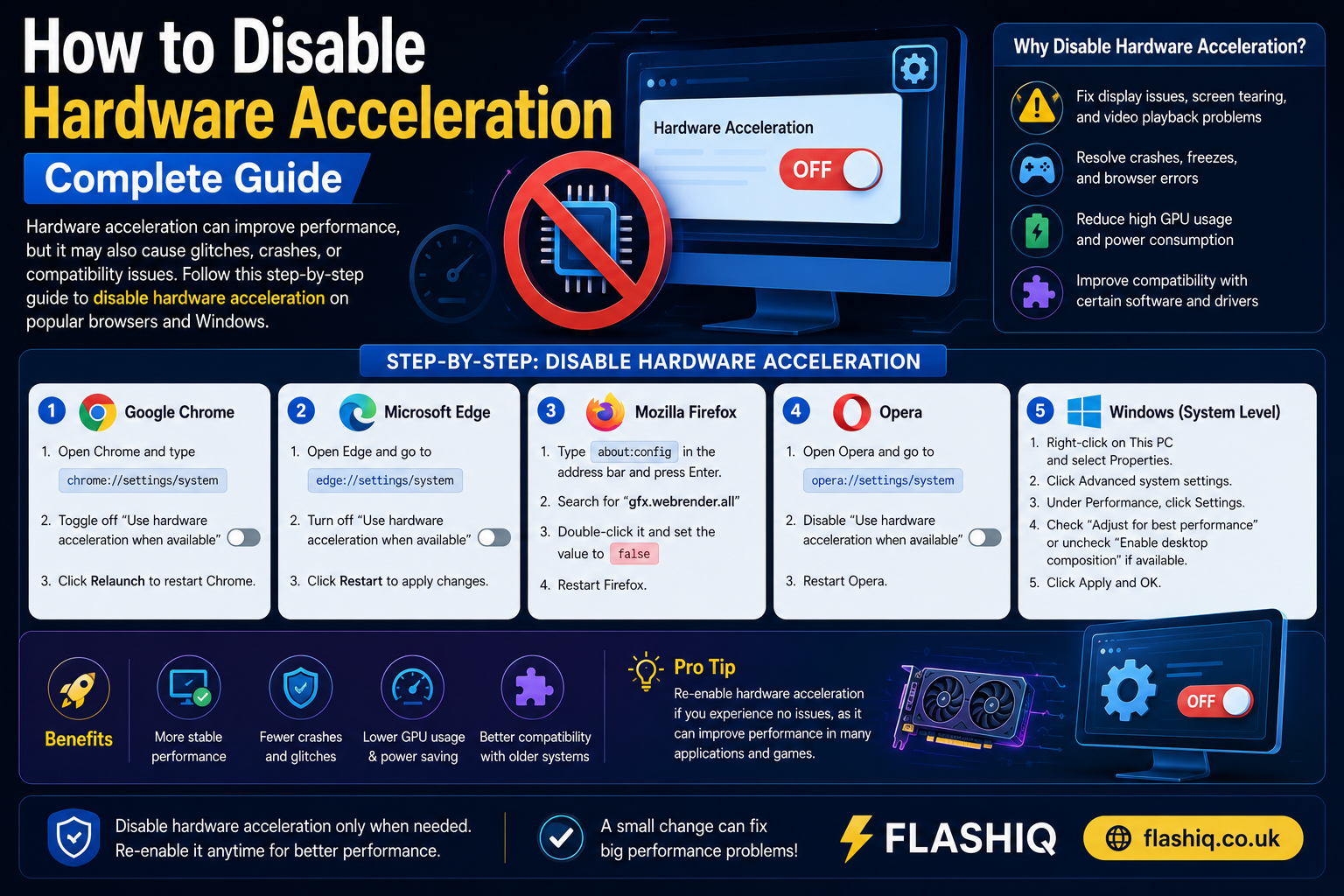
How to Disable Hardware Acceleration Complete Guide
If you’ve been experiencing screen flickering, application crashes, video playback issues, or unusual lag, learning how to disable hardware acceleration may solve the problem. Hardware acceleration is designed to improve performance by allowing your GPU (Graphics Processing Unit) to handle demanding tasks instead of relying solely on your CPU. While this usually improves speed and efficiency, it can sometimes create compatibility issues with graphics drivers, older hardware, or specific software.
Understanding how to disable hardware acceleration is useful whether you’re using Windows, macOS, Google Chrome, Microsoft Edge, Discord, Microsoft Office, or other popular applications. Turning this feature off can improve stability when troubleshooting graphical glitches or software crashes.
This guide explains everything you need to know about how to disable hardware acceleration, when to turn it off, its advantages and disadvantages, and the software that commonly supports this feature.
Quick Summary
| Feature | Details |
|---|---|
| Keyword | how to disable hardware acceleration |
| Difficulty | Beginner |
| Time Required | 2–10 Minutes |
| Platforms | Windows, macOS, Linux |
| Browsers | Chrome, Edge, Firefox (partial support) |
| Common Issues Fixed | Flickering, crashes, lag, black screens |
| Safe to Disable? | Yes |
| Can Be Re-enabled? | Yes |
| Best For | Troubleshooting graphics issues |
What Is Hardware Acceleration?
Hardware acceleration is a technology that allows software to use specialized computer hardware—typically the graphics card—to perform tasks faster than the CPU alone.
Instead of processing animations, videos, games, or visual effects through the processor, applications send these workloads to the GPU.
Learning how to disable hardware acceleration becomes important when GPU drivers conflict with applications or when graphics hardware behaves unexpectedly.
Common Tasks Using Hardware Acceleration
- Video streaming
- Video editing
- Gaming
- 3D rendering
- Web browsing
- Graphic design
- Animation
- Office applications
Why Learn How to Disable Hardware Acceleration?
There are many situations where users search for how to disable hardware acceleration.
Common Reasons
- Random crashes
- Screen flickering
- Browser freezes
- High GPU usage
- Discord black screen
- Microsoft Office lag
- Streaming issues
- Driver compatibility problems
Disabling hardware acceleration often helps identify whether the graphics card or software is causing the issue.
Signs You Should Disable Hardware Acceleration
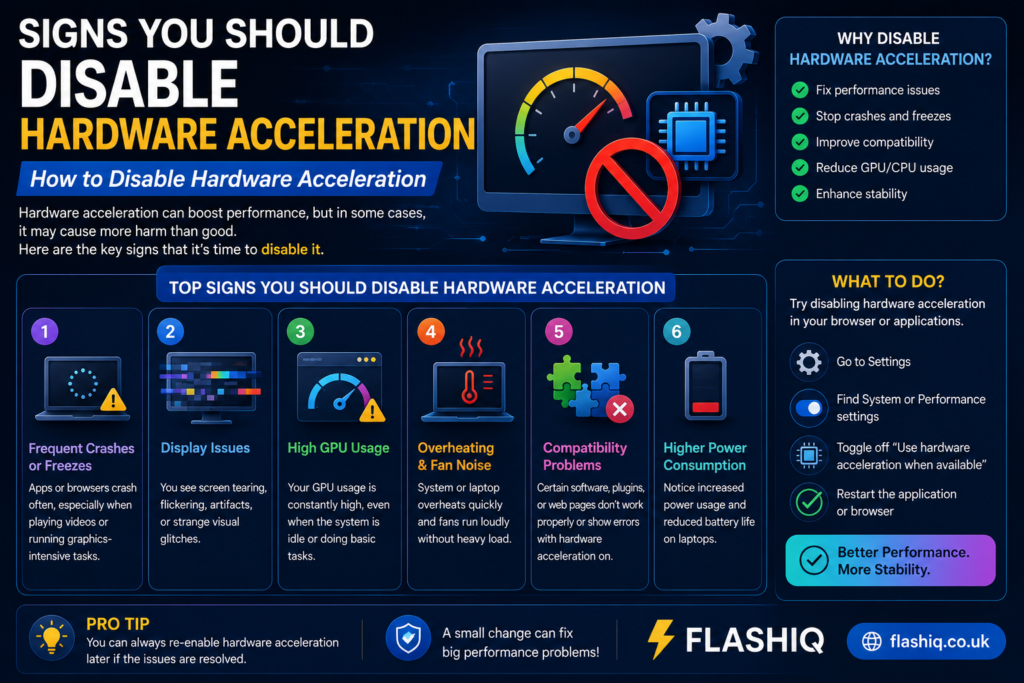
If you notice any of these problems, learning how to disable hardware acceleration may help:
- Videos appear choppy.
- Browser freezes randomly.
- Black screen after opening software.
- Mouse lag.
- Screen tearing.
- Rendering errors.
- Visual glitches.
- Unexpected crashes.
Benefits of Disabling Hardware Acceleration
Turning this feature off doesn’t always improve performance, but it can improve stability.
Benefits include:
- Better compatibility
- Fewer crashes
- Stable rendering
- Easier troubleshooting
- Reduced driver conflicts
- Improved compatibility with older GPUs
Knowing how to disable hardware acceleration can save time when diagnosing persistent software issues.
Drawbacks of Disabling Hardware Acceleration
There are also disadvantages.
- Higher CPU usage
- Reduced graphics performance
- Slower video rendering
- Less efficient gaming
- Increased battery usage on laptops
- Lower FPS in graphics-intensive applications
Because of this, users should only disable it when necessary.
Where Can You Disable Hardware Acceleration?
Many applications include this option.
Examples include:
- Google Chrome
- Microsoft Edge
- Discord
- Microsoft Office
- Adobe Photoshop
- Adobe Premiere Pro
- OBS Studio
- Spotify
- Zoom
- Steam
- Visual Studio Code
Each application uses slightly different settings.
Software Comparison Table
| Software | Supports Hardware Acceleration | Where to Disable | Best For | Difficulty |
|---|---|---|---|---|
| Google Chrome | Yes | Settings → System | Browser issues | Easy |
| Microsoft Edge | Yes | Settings → System and Performance | Browser stability | Easy |
| Discord | Yes | Advanced Settings | Gaming chats & streaming | Easy |
| Microsoft Office | Yes | Options → Advanced → Display | Fix Office crashes | Medium |
| Adobe Photoshop | Yes | Preferences → Performance | Graphics editing issues | Medium |
What Happens After Disabling Hardware Acceleration?
Once you learn how to disable hardware acceleration, you may notice:
- Lower GPU usage
- Higher CPU usage
- More stable applications
- Fewer graphical glitches
- Better compatibility with outdated drivers
- Reduced crashes
- Smoother software behavior on problematic systems
For many users, these trade-offs are worthwhile when troubleshooting persistent graphics-related issues.
| Software | Supports Hardware Acceleration | Where to Disable | Best For | Difficulty |
|---|---|---|---|---|
| OBS Studio | Yes | Settings → Advanced → Video/Output | Recording and live streaming | Medium |
| Spotify | Yes | Settings → Compatibility | Audio playback and UI issues | Easy |
| Zoom | Yes | Settings → Video → Advanced | Video conferencing stability | Easy |
| Steam | Yes | Interface/Web View Settings (varies by version) | Gaming client performance | Medium |
| Visual Studio Code | Yes | Launch option (--disable-gpu) or settings | Fix rendering and display glitches | Advanced |
Feature Comparison Table
| Software | Windows | macOS | Linux | Easy to Disable | Best for Troubleshooting | Recommended for Beginners |
|---|---|---|---|---|---|---|
| Google Chrome | ✔ | ✔ | ✔ | ✔ | ✔ | ✔ |
| Microsoft Edge | ✔ | ✔ | ✔ | ✔ | ✔ | ✔ |
| Discord | ✔ | ✔ | ✔ | ✔ | ✔ | ✔ |
| Microsoft Office | ✔ | ✔ | Limited | Moderate | ✔ | Moderate |
| Adobe Photoshop | ✔ | ✔ | ✖ | Moderate | ✔ | Moderate |
| OBS Studio | ✔ | ✔ | ✔ | Moderate | ✔ | Moderate |
| Spotify | ✔ | ✔ | ✔ | ✔ | Moderate | ✔ |
| Zoom | ✔ | ✔ | ✔ | ✔ | ✔ | ✔ |
| Steam | ✔ | ✔ | ✔ | Moderate | Moderate | Moderate |
| Visual Studio Code | ✔ | ✔ | ✔ | Moderate | ✔ | Advanced |
Pricing Comparison Table
| Software | Free Version | Paid Version | Hardware Acceleration Available |
|---|---|---|---|
| Google Chrome | Free | No | Yes |
| Microsoft Edge | Free | No | Yes |
| Discord | Free | Discord Nitro (Optional) | Yes |
| Microsoft Office | Trial Available | Microsoft 365 Subscription | Yes |
| Adobe Photoshop | Trial Available | Subscription Required | Yes |
| OBS Studio | Free | No | Yes |
| Spotify | Free | Spotify Premium | Yes |
| Zoom | Free | Paid Plans | Yes |
| Steam | Free | Game Purchases Optional | Yes |
| Visual Studio Code | Free | No | Yes |
How to Choose the Right Software
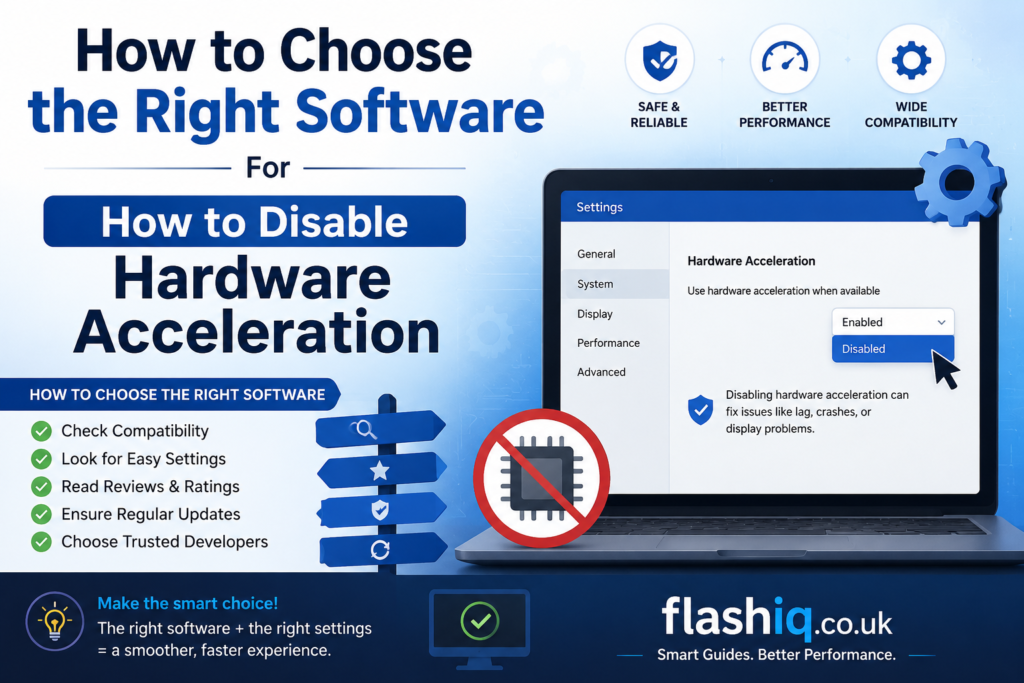
If you’re deciding where to learn how to disable hardware acceleration, start with the application that’s causing problems. Each program has its own settings, so you only need to disable hardware acceleration in the affected software rather than across your entire system.
Consider these factors before making changes:
- Identify which application is crashing or displaying graphical glitches.
- Update your graphics drivers before disabling hardware acceleration.
- Restart the application after changing the setting.
- Test performance both before and after disabling it.
- Re-enable hardware acceleration if performance becomes noticeably worse.
- Keep your operating system and software up to date for the best compatibility.
Our Recommendation
For most users, hardware acceleration should remain enabled because it improves graphics performance, smoother video playback, and overall responsiveness. However, if you’re experiencing persistent crashes, screen flickering, black screens, or rendering issues, learning how to disable hardware acceleration is one of the quickest troubleshooting steps you can take.
If you’re unsure where to begin:
- Disable it first in your web browser if browsing issues occur.
- Turn it off in Discord if screen sharing or streaming is unstable.
- Disable it in Microsoft Office if documents flicker or crash.
- For creative software like Photoshop or OBS Studio, test both enabled and disabled modes to see which offers better stability on your hardware.
Conclusion
Knowing how to disable hardware acceleration is a valuable troubleshooting skill for Windows, macOS, and Linux users. While hardware acceleration is designed to improve speed by offloading tasks to your graphics processor, it isn’t always the best option for every computer or application.
If you experience crashes, graphical glitches, video playback problems, or software instability, temporarily disabling hardware acceleration can help identify and resolve the issue. Since every application manages this feature differently, always check its settings and restart the program after making changes.
In most cases, once driver updates or software patches resolve compatibility problems, you can safely turn hardware acceleration back on to enjoy the performance benefits.
Frequently Asked Questions (FAQs)
1. What is hardware acceleration?
Hardware acceleration allows software to use your GPU instead of the CPU for graphics-intensive tasks, improving performance and efficiency.
2. Is it safe to disable hardware acceleration?
Yes. Disabling hardware acceleration is safe and reversible. It only changes how the application processes graphics.
3. Will disabling hardware acceleration improve performance?
Not always. It may improve stability and reduce crashes but can also increase CPU usage and reduce graphics performance.
4. Should gamers disable hardware acceleration?
Generally, no. Gamers usually benefit from keeping it enabled unless they encounter specific compatibility or rendering issues.
5. Does disabling hardware acceleration affect video playback?
It can. Video playback may rely more on the CPU, which could increase processor usage on older computers.
6. Can I re-enable hardware acceleration later?
Yes. You can turn it back on at any time by returning to the application’s settings and restarting the program if required.
7. Why does hardware acceleration cause problems?
Issues typically occur because of outdated graphics drivers, software bugs, GPU compatibility problems, or conflicts with operating system updates.
8. Which applications commonly use hardware acceleration?
Popular applications include Google Chrome, Microsoft Edge, Discord, Microsoft Office, Adobe Photoshop, OBS Studio, Spotify, Zoom, Steam, and Visual Studio Code.
Quick Bio
About the Author
The FlashIQ editorial team creates practical technology guides, software comparisons, and troubleshooting tutorials for everyday users. Our content focuses on clear, up-to-date, and beginner-friendly solutions to help readers solve common PC, software, and digital productivity challenges with confidence.