What Value Would Be Returned Based on the Formula in Cell D49? A Complete Beginner’s Guide
If you’ve ever encountered the question what value would be returned based on the formula in cell D49, you’re not alone. This is one of the most common questions found in spreadsheet training courses, certification exams, classroom assignments, and workplace assessments. Rather than simply asking you to perform a calculation, the question tests your ability to understand how spreadsheet formulas work and how different cell references interact with one another. Knowing what value would be returned based on the formula in cell D49 requires more than basic arithmetic—it involves reading formulas correctly, recognizing functions, evaluating references, and understanding Excel or Google Sheets calculation rules. Whether you’re using Microsoft Excel, Google Sheets, or another spreadsheet application, the principles remain largely the same. Once you understand those principles, you’ll be able to answer similar questions with confidence. This guide explains everything in a simple, practical way without assuming advanced spreadsheet knowledge.
Quick Answer
The answer to what value would be returned based on the formula in cell D49 depends entirely on the actual formula written in cell D49 and the values contained in the referenced cells. Without seeing the worksheet, there is no single numeric answer. However, you can determine the correct value by identifying the formula, following the order of operations, evaluating every referenced cell, and applying any spreadsheet functions exactly as written. This process works consistently across Excel, Google Sheets, LibreOffice Calc, and similar spreadsheet software. Learning this evaluation process is the key skill behind solving these questions accurately.
What Does “What Value Would Be Returned Based on the Formula in Cell D49” Mean?
The phrase what value would be returned based on the formula in cell D49 refers to determining the final result produced by a spreadsheet formula after Excel or another spreadsheet application completes every calculation. Instead of asking you to create a formula, the question focuses on interpreting an existing one. This requires examining every cell reference, understanding each mathematical operator, and evaluating any functions included within the formula. In many spreadsheet exams, the worksheet already contains numbers, text, dates, or logical values that influence the result. Your task is to mentally calculate or verify the outcome exactly as the spreadsheet software would. Questions like what value would be returned based on the formula in cell D49 are designed to measure your understanding of spreadsheet logic rather than your memorization of formulas. Once you learn how spreadsheets evaluate formulas, these questions become much easier to solve regardless of the worksheet’s complexity.
Why Spreadsheet Formula Questions Matter
Understanding what value would be returned based on the formula in cell D49 is an essential spreadsheet skill because businesses rely on formulas for reporting, forecasting, budgeting, inventory tracking, payroll, and financial analysis. Employees often need to verify calculations before making important decisions. Even a small misunderstanding of a formula can produce incorrect reports or inaccurate financial statements. Educational institutions also include these questions in spreadsheet certification exams because they demonstrate whether students truly understand how formulas operate. Instead of blindly trusting spreadsheet outputs, experienced users know how to verify calculations independently. Learning this skill also helps troubleshoot errors when formulas return unexpected values. The better you understand what value would be returned based on the formula in cell D49, the more confident you’ll become when working with large datasets and complex spreadsheets.
Understanding Spreadsheet Formulas Before Evaluating Cell D49
Before answering what value would be returned based on the formula in cell D49, it’s important to understand what a spreadsheet formula actually is. Every formula begins with an equal sign, telling the spreadsheet to perform a calculation rather than display ordinary text. Formulas can contain numbers, arithmetic operators, functions, cell references, logical expressions, and even nested formulas. When you press Enter, Excel evaluates every component according to its built-in calculation rules. The final value displayed inside the cell is called the returned value or formula result. Understanding these components makes it much easier to predict what any spreadsheet formula will produce. Without this foundation, determining what value would be returned based on the formula in cell D49 becomes much more difficult, especially when formulas involve multiple functions working together.
Common Components of Spreadsheet Formulas
| Formula Component | Purpose | Example |
|---|---|---|
| Cell Reference | Uses another cell’s value | A1 |
| Operator | Performs calculations | +, -, *, / |
| Function | Executes built-in operations | SUM(), IF(), AVERAGE() |
| Constant | Fixed value | 100 |
| Parentheses | Controls calculation order | (A1+B1) |
Understanding Cell References
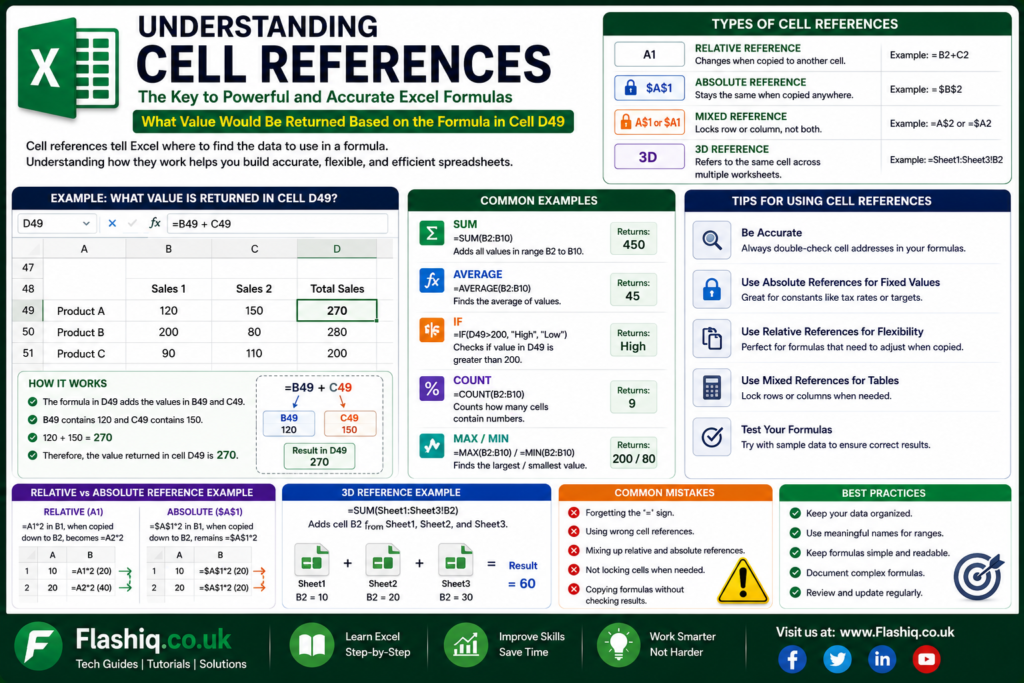
Cell references are the backbone of determining what value would be returned based on the formula in cell D49. Instead of storing every number directly inside a formula, spreadsheets reference other cells that already contain values. This approach keeps worksheets dynamic because changing one referenced cell automatically updates every formula that depends on it. References may be relative, absolute, or mixed depending on how they’re written. Relative references change when formulas are copied, while absolute references remain fixed using dollar signs. Mixed references combine characteristics of both. Recognizing the type of reference helps predict how formulas behave throughout a worksheet. This knowledge becomes especially valuable when analyzing formulas in tables, reports, and financial models where many cells depend on one another.
Relative References
Relative references adjust automatically when formulas are copied to another location. For example, if D49 contains =B49+C49, copying it to D50 changes the formula to =B50+C50. Spreadsheet applications do this automatically because relative references are designed to follow the formula’s new location. Many exam questions involving what value would be returned based on the formula in cell D49 intentionally test whether you recognize this behavior. If you misunderstand relative references, you’ll likely calculate the wrong result. Fortunately, once you understand how they move, evaluating formulas becomes much more predictable.
Absolute References
Absolute references remain fixed regardless of where the formula is copied. They use dollar signs, such as $A$1. If cell D49 references $A$1, the formula always points to that exact cell. This feature is especially useful when calculating taxes, commission rates, exchange rates, or fixed percentages stored in one location. Understanding absolute references helps explain why some formulas always return values based on the same reference, even after being copied throughout a worksheet. Questions involving what value would be returned based on the formula in cell D49 frequently include absolute references because they test deeper spreadsheet knowledge.
How Excel Evaluates Formulas in Cell D49
When determining what value would be returned based on the formula in cell D49, Excel follows a predictable calculation process. First, it identifies every referenced cell. Next, it retrieves the stored values from those cells. Then, it evaluates functions such as SUM, AVERAGE, IF, MAX, or MIN according to their syntax. Mathematical operations are performed following the standard order of operations, with parentheses evaluated before multiplication and division, followed by addition and subtraction. Logical functions evaluate conditions before deciding which value to return. Finally, Excel displays the completed result inside cell D49. Because the calculation process always follows consistent rules, understanding these rules allows you to determine the returned value even before opening the spreadsheet.
Order of Operations Used by Spreadsheet Software
Excel uses a calculation hierarchy similar to standard mathematics. Understanding this hierarchy is essential when answering what value would be returned based on the formula in cell D49 because changing the calculation order can produce completely different results.
| Priority | Operation |
|---|---|
| 1 | Parentheses |
| 2 | Exponents |
| 3 | Multiplication and Division |
| 4 | Addition and Subtraction |
For example, the formula:
=5+3*2
returns 11, not 16, because multiplication occurs before addition. If the formula becomes:
=(5+3)*2
the returned value changes to 16 because parentheses override the normal calculation order. Understanding this rule is fundamental when solving spreadsheet formula questions accurately.
Examples of Determining What Value Would Be Returned Based on the Formula in Cell D49
Understanding what value would be returned based on the formula in cell D49 becomes much easier when you work through realistic examples. Spreadsheet questions often include a small data table and ask you to determine the final output without opening the software. By evaluating each referenced cell one step at a time, you can confidently identify the correct answer. The key is to avoid guessing and instead follow Excel’s calculation sequence exactly as the application would. In many certification exams, the formula itself is straightforward, but the challenge comes from understanding the referenced values or nested functions. Practicing with different formula types builds confidence and helps you recognize common patterns. Whether the worksheet contains sales data, grades, inventory numbers, or financial figures, the evaluation method remains consistent. The more examples you solve, the faster you will determine what value would be returned based on the formula in cell D49 during tests or real-world spreadsheet tasks.
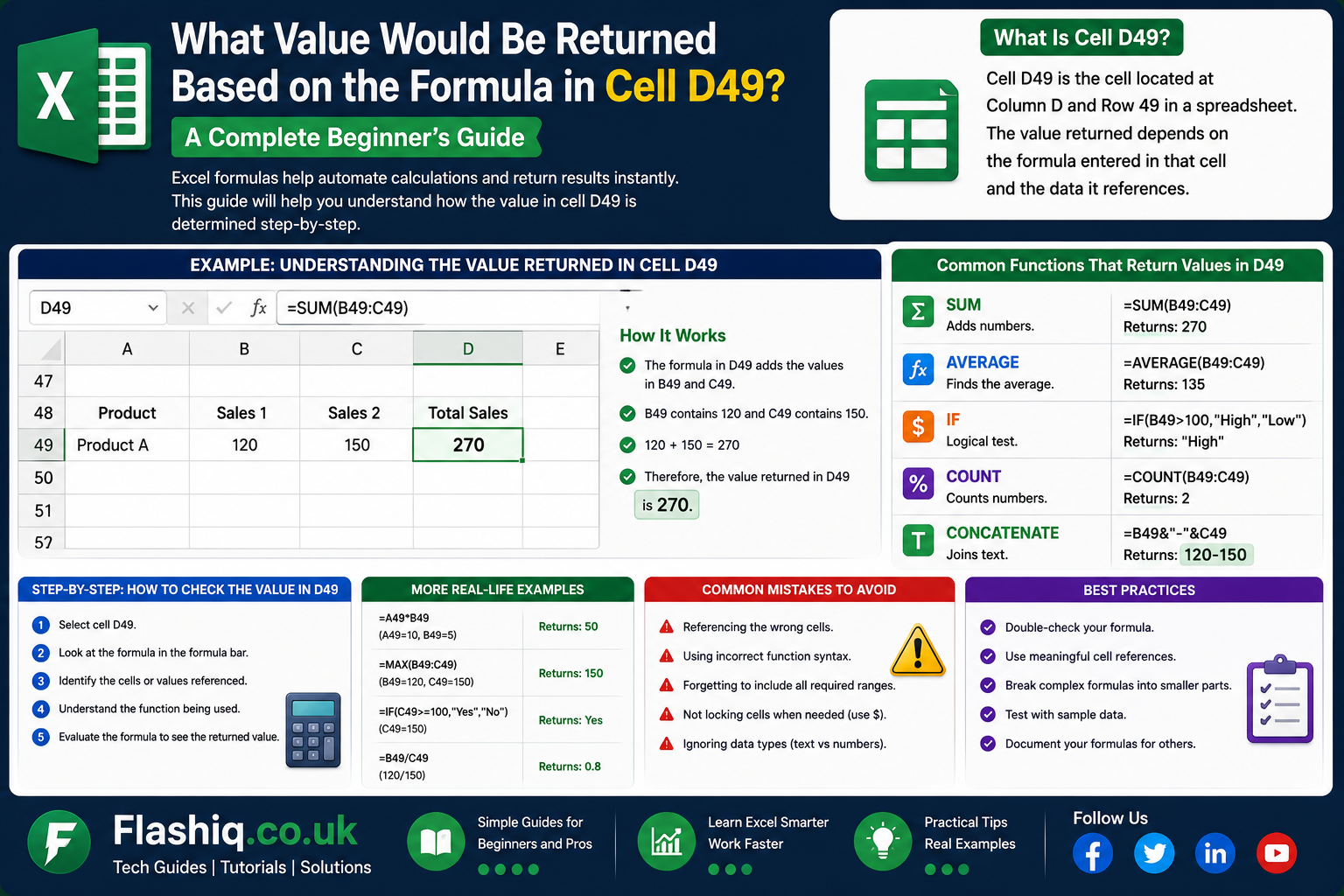
Example 1: SUM Function
Suppose cell D49 contains:
=SUM(B49:C49)If:
| Cell | Value |
|---|---|
| B49 | 25 |
| C49 | 15 |
The returned value is:
40
Excel simply adds the values from B49 and C49 before displaying the result in D49.
Example 2: IF Function
Assume D49 contains:
=IF(B49>=60,"Pass","Fail")If B49 contains 72, the formula returns:
Pass
If B49 contains 45, the formula returns:
Fail
Logical functions are common in spreadsheet assessments because they test both formula syntax and logical reasoning.
Example 3: AVERAGE Function
Formula:
=AVERAGE(B45:B48)If the cells contain:
20, 30, 40, and 50
The returned value is:
35
Excel calculates the arithmetic mean by adding all values and dividing by the number of cells.
Understanding Common Functions That Affect Cell D49
When solving what value would be returned based on the formula in cell D49, you will encounter a variety of spreadsheet functions. Each function performs a different task and influences the returned value in its own way. Some formulas perform simple arithmetic, while others evaluate conditions, search for information, count entries, or manipulate text. Becoming familiar with these commonly used functions significantly improves your ability to interpret formulas correctly. It also reduces mistakes during spreadsheet exams and workplace projects. Instead of memorizing every available function, focus first on those used most frequently in business, education, and data analysis. Once you understand how these functions behave, determining what value would be returned based on the formula in cell D49 becomes a logical process rather than a guessing game.
Frequently Used Spreadsheet Functions
| Function | Purpose | Example Result |
|---|---|---|
| SUM | Adds numbers | Total sales |
| AVERAGE | Calculates mean | Average score |
| COUNT | Counts numeric cells | Number of entries |
| IF | Performs logical test | Pass or Fail |
| MAX | Largest value | Highest sale |
| MIN | Smallest value | Lowest expense |
| ROUND | Rounds numbers | 25.48 → 25.5 |
| VLOOKUP | Finds matching data | Product price |
| INDEX | Returns data by position | Selected value |
| MATCH | Finds item location | Row number |
How to Analyze Complex Formulas
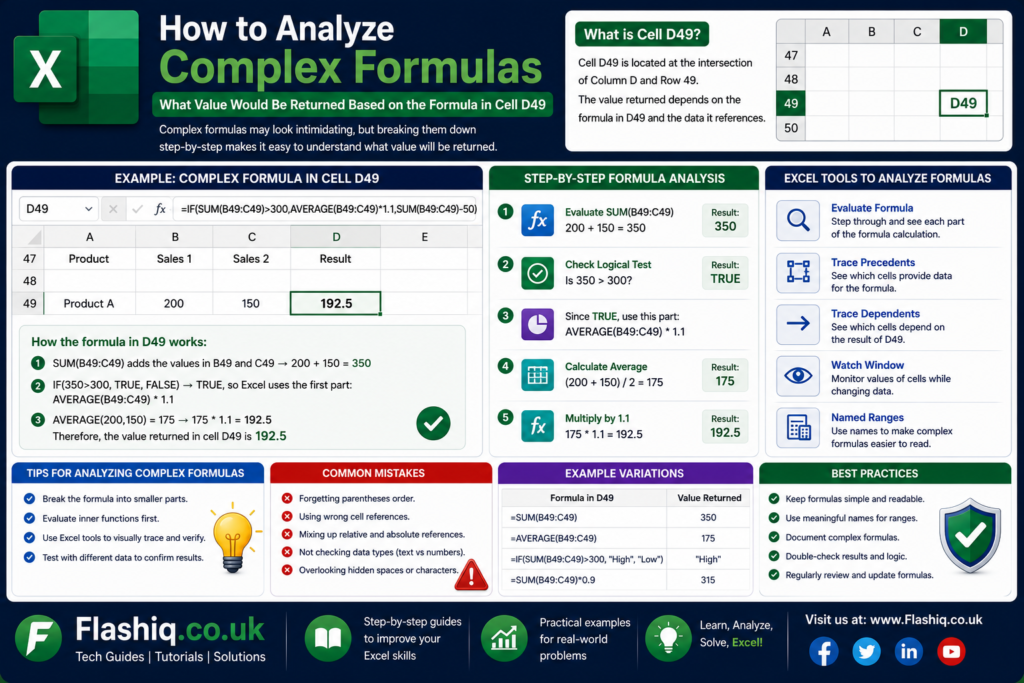
Some spreadsheet questions involve nested functions, multiple operators, and several referenced ranges. In these situations, determining what value would be returned based on the formula in cell D49 requires patience and a systematic approach. Begin by identifying the outermost function, then work inward through each nested function until every calculation is complete. Evaluate cell references carefully to ensure you are using the correct values. Pay close attention to parentheses because they determine which calculations occur first. If the formula contains logical functions such as IF, AND, or OR, determine whether the condition evaluates to TRUE or FALSE before continuing. For lookup functions, verify that the lookup value exists within the specified range. Breaking a complex formula into smaller pieces makes it much easier to understand and minimizes calculation errors. This structured method is exactly how experienced spreadsheet users solve advanced formula questions efficiently.
Tips for Breaking Down Large Formulas
Identify Every Referenced Cell
Write down each referenced cell and its current value before attempting the calculation.
Evaluate Nested Functions First
Inner functions almost always produce values that become inputs for outer functions.
Follow Excel’s Order of Operations
Never skip parentheses or assume calculations occur left to right.
Verify Data Types
Ensure the referenced values are numbers, dates, logical values, or text because functions behave differently depending on the data type.
Excel vs Google Sheets Formula Evaluation
Although Microsoft Excel and Google Sheets share many similarities, there are small differences in supported functions and advanced features. Fortunately, when answering what value would be returned based on the formula in cell D49, both applications evaluate standard formulas almost identically. Basic arithmetic, logical functions, averages, sums, and most commonly used functions return the same results. Differences usually appear only with newer functions, compatibility features, or platform-specific capabilities. Therefore, once you learn the core evaluation process, you can confidently apply the same knowledge in either spreadsheet application. This flexibility is especially useful for students and professionals who switch between platforms regularly.
| Feature | Excel | Google Sheets |
|---|---|---|
| Basic arithmetic | ✔ | ✔ |
| SUM function | ✔ | ✔ |
| IF function | ✔ | ✔ |
| AVERAGE | ✔ | ✔ |
| Relative references | ✔ | ✔ |
| Absolute references | ✔ | ✔ |
| Dynamic calculations | ✔ | ✔ |
Best Practices
When determining what value would be returned based on the formula in cell D49, following proven spreadsheet practices improves both speed and accuracy. Always begin by reading the complete formula instead of focusing only on the first function. Verify every referenced cell before performing calculations because a single incorrect value changes the final result. Follow Excel’s order of operations without making assumptions about calculation order. Break large formulas into smaller parts whenever they appear complicated, and evaluate nested functions individually before combining the results. If possible, use Excel’s Evaluate Formula feature to confirm your reasoning during practice sessions. Maintain organized worksheets with clearly labeled data to reduce confusion, especially in large spreadsheets. Finally, develop the habit of checking your final answer against the worksheet to ensure it is logical and consistent with the available data.
Common Mistakes
Many users struggle with what value would be returned based on the formula in cell D49 because they overlook small but important details. One of the most common mistakes is ignoring parentheses, which changes the calculation order and produces incorrect results. Another frequent error involves confusing relative references with absolute references, particularly after formulas have been copied across multiple cells. Some users also forget that logical functions return different outputs depending on whether a condition evaluates as TRUE or FALSE. Misreading cell values, overlooking hidden decimals, or assuming text values are numbers can also lead to inaccurate answers. Beginners sometimes calculate formulas manually without following Excel’s evaluation rules, resulting in inconsistent outcomes. By recognizing these common pitfalls, you can avoid unnecessary errors and solve spreadsheet questions with greater confidence.
Pro Tips
Experienced spreadsheet users rely on several techniques to determine what value would be returned based on the formula in cell D49 more efficiently. Use the Formula Bar to inspect long formulas without truncation. Learn keyboard shortcuts that simplify formula editing and navigation, especially when working with large workbooks. Color-coded cell references make it easier to identify which cells contribute to a calculation. Practice using the Evaluate Formula tool in Excel to observe calculations one step at a time. When troubleshooting unexpected results, temporarily replace complex sections with simpler expressions to isolate the issue. Familiarize yourself with common spreadsheet functions because recognizing patterns speeds up interpretation. Finally, practice with real-world datasets rather than isolated examples to strengthen your analytical skills and prepare for certification exams or workplace tasks.
Conclusion
Understanding what value would be returned based on the formula in cell D49 is a fundamental spreadsheet skill that applies to Microsoft Excel, Google Sheets, LibreOffice Calc, and many other spreadsheet applications. Rather than searching for a single universal answer, the correct approach is to evaluate the actual formula, examine every referenced cell, and follow the spreadsheet’s calculation rules step by step. Once you understand how formulas, functions, operators, and cell references interact, even complex spreadsheet questions become much easier to solve. Regular practice with different formula types strengthens your analytical abilities and reduces errors in both academic and professional settings. Whether you’re preparing for an Excel certification exam, completing coursework, or analyzing business data, mastering formula evaluation will improve your confidence and efficiency. By applying the techniques, examples, and best practices covered in this guide, you will be well equipped to determine what value would be returned based on the formula in cell D49 accurately in virtually any spreadsheet scenario.
Frequently Asked Questions (FAQs)
1. What does “returned value” mean in Excel?
A returned value is the final result displayed after Excel evaluates a formula.
2. Can I determine the value without seeing the worksheet?
No. You need both the formula and the values in the referenced cells to calculate the exact result.
3. Does Google Sheets calculate formulas the same way as Excel?
Yes. For most common functions and arithmetic operations, both applications return identical results.
4. Why is cell D49 commonly used in spreadsheet questions?
It is simply an example cell location used in educational materials, assessments, and certification exams.
5. What happens if a referenced cell is empty?
Depending on the formula, Excel may treat the empty cell as zero, ignore it, or return an error.
6. How can I check each calculation step in Excel?
Use the Evaluate Formula feature found under the Formulas tab to inspect calculations step by step.
7. What is the difference between a formula and a function?
A formula is an expression beginning with an equals sign, while a function is a predefined operation used within a formula.
8. Why do parentheses matter in formulas?
Parentheses determine which calculations Excel performs first and can completely change the returned value.
9. Are spreadsheet certification exams based on real formulas?
Yes. Most certification exams use practical spreadsheet scenarios that reflect real business tasks.
10. What is the fastest way to improve formula evaluation skills?
Practice solving spreadsheet problems regularly, learn common functions, and use Excel’s built-in evaluation tools to verify your work.
Author Bio
About the Author
The author is an experienced SEO content writer and technology researcher specializing in spreadsheet software, Microsoft Excel, Google Sheets, business productivity tools, and digital education. With extensive experience creating user-focused technical guides, the author develops content that follows Google’s EEAT principles, simplifies complex topics, and helps readers build practical skills through accurate, well-researched, and easy-to-understand explanations.